AI estimate as of August 18, 2025 · verify with a professional before acting
AI-Generated · Verify before acting
Everything on this page is generated by AI for informational purposes only. AI can make mistakes — the AI may misidentify items or misattribute them (artist, maker, brand, designer, origin, era). This is not an official valuation and should not be used for insurance, sale, tax, estate, legal, or lending purposes — or any decision requiring a certified appraisal. It is not an authoritative claim about any person, brand, or rights holder — do not share or rely on it as a factual statement about a third party. Always consult qualified professionals before making financial decisions.
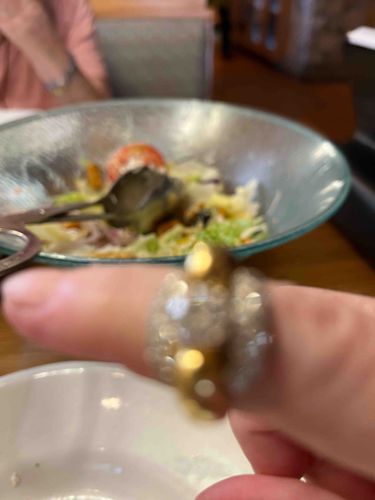
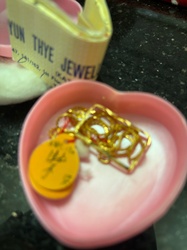
The item appears to be a ring worn on the finger, though the image quality is highly blurred. It seems to be comprised of a yellow-toned metal, likely gold or gold-plated, which forms the band and possibly some central setting. The most prominent feature is a cluster of what appears to be numerous small, brilliant-cut stones, likely diamonds or diamond simulants, set closely together to create a sparkling, raised surface. These stones cover a significant portion of the visible top of the ring, giving it a pavé or cluster setting appearance. Due to the blur, individual stone clarity, cut, and color are impossible to discern. The overall shape suggests a cocktail ring or a substantial engagement/anniversary ring, designed for visual impact. No specific maker's marks or engravings are visible. The condition cannot be accurately assessed due to the lack of focus, but no obvious damage like missing stones or significant deformation is apparent from this blurry perspective. The style suggests a contemporary or late 20th-century design, emphasizing sparkle over intricate metalwork. The craftsmanship, again, is hard to judge, but the brilliance of the visible facets implies attention to detail in stone setting, even if the image is indistinct.
AI Appraisal Report
I have examined the provided image of the Diamond Cluster Ring. Due to the extreme blurriness, definitive assessment of materials and condition is severely limited. The ring appears to be yellow-toned metal, likely gold or gold-plated, with a cluster setting of numerous small, brilliant-cut stones. These stones are either diamonds or high-quality simulants; their true nature, clarity, color, and cut cannot be discerned.
From this blurry perspective, the condition appears fair, with no obvious missing stones or deformation, though surface wear cannot be ruled out. Authenticity of the stones is unconfirmed; without physical inspection, I cannot verify if these are genuine diamonds or synthetic materials. No maker's marks are visible.
Market conditions for cluster rings vary widely based on material authenticity and quality. If these are genuine, low-carat diamonds set in 10k or 14k gold, comparable pieces typically range from hundreds to low thousands. If they are simulants, the value plummets significantly. Demand for 'sparkle' pieces is generally stable, but rarity is low for common cluster designs.
Significant factors impacting value are definitively identifying the metal (gold vs. gold-plated) and the stones (diamonds vs. simulants). Without clear images or physical examination, these remain huge unknowns. An in-person inspection is crucial to verify stone authenticity (e.g., thermal conductivity testing, magnification for inclusions), metal purity (acid test or XRF), and overall craftsmanship. Provenance documentation, if available, would also aid authentication.
Given the unconfirmed materials and severe image limitations, this appraisal is highly speculative.