AI estimate as of July 11, 2025 · verify with a professional before acting
AI-Generated · Verify before acting
Everything on this page is generated by AI for informational purposes only. AI can make mistakes — the AI may misidentify items or misattribute them (artist, maker, brand, designer, origin, era). This is not an official valuation and should not be used for insurance, sale, tax, estate, legal, or lending purposes — or any decision requiring a certified appraisal. It is not an authoritative claim about any person, brand, or rights holder — do not share or rely on it as a factual statement about a third party. Always consult qualified professionals before making financial decisions.
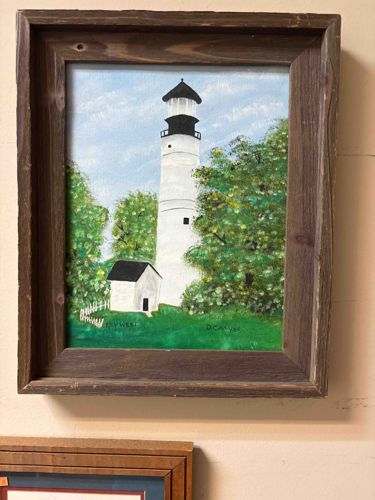
This is a rectangular folk art painting, likely executed in acrylics or oils on canvas or board, depicting a lighthouse scene. The central subject is a tall, white lighthouse with a black top, rendered with a somewhat stylized and simplified form, characteristic of folk art. To the left of the lighthouse, a small, white ancillary building with a black roof and a white picket fence is visible, nestled amidst lush green foliage. The lighthouse and building are surrounded by vibrant green trees and bushes, suggesting a natural, perhaps coastal, setting. The sky above is a light blue with subtle cloud formations. The color palette is bright and cheerful, dominated by greens, whites, and blues. The brushwork appears somewhat loose and expressive, focusing on capturing the essence of the scene rather than photorealistic detail. The painting is framed in a distressed or rustic dark wood frame, possibly barnwood or a similar material, with visible grain and natural imperfections, consistent with a folk art aesthetic. The frame has visible nail holes on the top edge, suggesting a somewhat rustic or handmade construction. There are two visible signatures or inscriptions: 'KEY WEST' in the lower left, indicating the location depicted, and 'D CARLYLE' (or similar, difficult to discern clearly) in the lower right, likely the artist's signature. The overall condition appears good, with no obvious signs of significant damage, tears, or fading, though the rustic nature of the frame could be mistaken for wear. The craftsmanship aligns with a naive or untrained artistic style, emphasizing charm and narrative over academic technique.
AI Appraisal Report
I have carefully examined the provided image of this folk art painting depicting the Key West Lighthouse. The condition appears to be good, with no obvious signs of significant damage, tears, or fading visible in the image. However, the rustic nature of the dark wood frame, with its visible grain and nail holes, could be mistaken for wear, but seems consistent with the folk art aesthetic. The brushwork and simplified forms strongly suggest an authentic naive or untrained artistic style, characteristic of folk art.
Market conditions for original folk art, particularly pieces with identifiable locations like 'Key West,' tend to be stable. Comparables would include other regional folk art landscapes or architectural depictions, often by lesser-known or self-taught artists. Demand for charming and narrative folk art pieces remains consistent among collectors who appreciate their unique character and often historical or regional appeal. This particular piece benefits from depicting a recognizable landmark, 'Key West,' which enhances its desirability. The presence of a signature, 'D CARLYLE' (though difficult to discern clearly from the image), is also a positive factor, providing potential for artist identification.
Factors significantly impacting value include the charming subject matter, the apparent good condition, and the regional appeal. Limitations in authenticity verification from images alone are considerable. I cannot definitively confirm the artist's identity ('D CARLYLE') or the specific medium (oils vs. acrylics). For full authentication, an in-person examination would be crucial to assess surface texture, pigment type, and the quality of the canvas or board. Provenance documentation, such as exhibition history or previous ownership records, would be invaluable. Additionally, forensic analysis or scientific testing could confirm the age of the materials used. Without these, the appraisal remains based on visual assessment of the image provided.