AI Appraisal Estimate

AI-generated estimates · not official valuations

From the user

What was submitted

Photo and notes provided by the user — not generated by AI

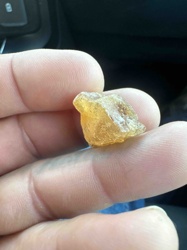
Submitted item photo
Submitted photo · June 3, 2026

User's notes

No additional notes provided.

AI analysis below

AI appraisal

AI analysis & estimate

AI-Generated · Verify before acting

Everything below is generated by AI for informational purposes only. AI can make mistakes — the AI may misidentify items or misattribute them (artist, maker, brand, designer, origin, era). This is not an official valuation and should not be used for insurance, sale, tax, estate, legal, or lending purposes — or any decision requiring a certified appraisal. It is not an authoritative claim about any person, brand, or rights holder — do not share or rely on it as a factual statement about a third party. Always consult qualified professionals before making financial decisions.

Read the full disclaimer

AI Identification

·Not independently authenticated·Verify before acting

Raw Black Tourmaline Crystal

Minerals and Gemstones

AI Estimated Value

·Not an official valuation·Verify before acting

$10 - $25

As of June 3, 2026

AI Item Analysis

·AI can make mistakes·Verify before acting
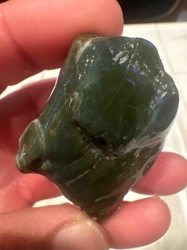
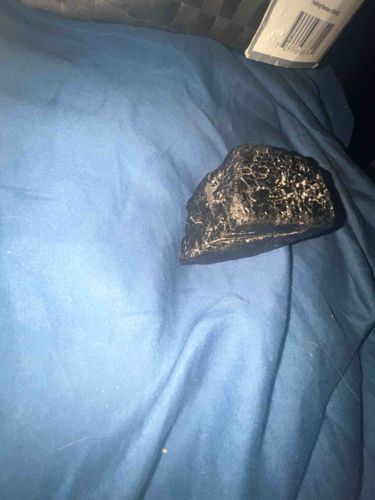
This is a specimen of raw black tourmaline, also known as Schorl. The item exhibits the characteristic trigonal crystal system typical of the species, displaying prominent vertical striations and a vitreous to sub-metallic luster on its various faces. Geometrically, it is an irregular, chunky block approximately 2 to 3 inches in length. Its color is a deep, opaque jet-black. The texture is markedly rugged and crystalline, showing significant fragmentation and natural fracturing along the grain. Fine white or light-colored mineral inclusions or surface dust are visible within the crevices, providing a sharp contrast to the dark core. The condition appears to be strictly raw and unpolished, with sharp, jagged edges and no evidence of human craftsmanship or mechanical tumble-finishing. This specimen likely originates from a pegmatite formation. There are no maker's marks, as it is a natural mineral specimen. The quality represents a standard cabinet-grade specimen often used for decorative purposes or by collectors of metaphysical stones. Natural wear includes surface crumbling and small crystalline chips common to tourmaline's brittle nature.
AI Appraisal Report

·AI can make mistakes·Verify before acting
Upon examining the provided imagery of this raw Black Tourmaline specimen, commonly classified as Schorl, I can confirm it displays the quintessential characteristics of the species. The specimen exhibits the classic trigonal crystal structure with distinct vertical striations running along the c-axis, a key identifier for authentic tourmaline. The luster appears vitreous to sub-metallic, and the opaque, jet-black coloration is consistent with high-iron content Schorl. Measuring approximately 2 to 3 inches, this is a standard ‘chunky’ cabinet specimen. The condition is raw and stable, though the visible crumbling and sharp, jagged edges reflect the mineral's natural brittleness (Mohs hardness 7-7.5) rather than damage that would diminish value in this grade. The light-colored inclusions or matrix residue in the crevices suggest a pegmatite origin, likely from prolific localities such as Brazil, Madagascar, or Namibia. Market conditions for Black Tourmaline are currently saturated, as it is one of the most abundant minerals in the tourmaline family. Demand remains steady, primarily driven by the metaphysical market and novice collectors, rather than high-end mineral investment. Consequently, this piece is not rare; it is a functional, decorative geological sample rather than a museum-quality aesthetic crystal. Value is driven strictly by weight and size rather than gemological clarity. It is important to note that while the visual indicators strongly support authenticity, complete verification of specific provenance is impossible via images alone. To distinguish this from distinct lookalikes like black hornblende or augite, I would need to perform a physical scratch test or measure specific gravity. However, given the low commercial risk and distinct striations, I am confident in assessing this as a genuine Black Tourmaline specimen.

Get your items appraised

Instant estimates of your treasures with AI-powered appraisals

Browse More Appraisals