AI identification & appraisal estimate

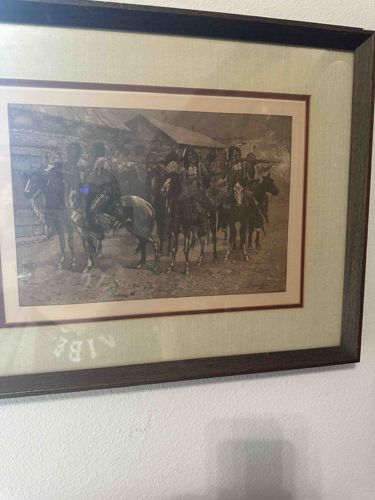
Historical Native American Equestrian Scene Print

Submitted photo of Historical Native American Equestrian Scene Print
Photo submitted by the user — not generated by AI

AI Estimated Value

Not an official valuation

$75-125

AI estimate as of July 12, 2025 · verify with a professional before acting

AI-Generated · Verify before acting

Everything on this page is generated by AI for informational purposes only. AI can make mistakes — the AI may misidentify items or misattribute them (artist, maker, brand, designer, origin, era). This is not an official valuation and should not be used for insurance, sale, tax, estate, legal, or lending purposes — or any decision requiring a certified appraisal. It is not an authoritative claim about any person, brand, or rights holder — do not share or rely on it as a factual statement about a third party. Always consult qualified professionals before making financial decisions.

Read the full disclaimer

AI Item Analysis

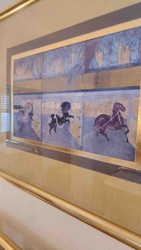
This item is a framed art print depicting a scene with a group of Native American figures on horseback, gathered in what appears to be a village or encampment setting, with structures visible in the background. The print is monochrome, likely sepia-toned or black and white, giving it a historical or antique feel. The image itself shows several horses and riders, with details visible in their attire and the horses' tack, suggesting a focus on historical accuracy or ethnographic depiction. The print is housed within a dark, possibly wooden, frame that has a simple, somewhat rustic profile. Inside the frame, there is a double matting system: an inner thin reddish-brown mat that closely borders the print, and a wider, light olive-green or beige outer mat. The glass covering the print shows some reflections, including a distinct 'VIBE' text appearing reversed, indicating it might be a reflection from an object in the room or a watermark on the glass itself. The overall condition appears good from the visible angle, with no obvious major damage to the frame or print, though a clearer view of the print itself is needed to assess specific condition issues like fading, foxing, or creasing. The style suggests it could be from the early to mid-20th century, consistent with historical Western art or ethnographic studies often reproduced in print form. The craftsmanship seems standard for a mass-produced framed print, with a focus on presenting the image neatly within its protective layers. A signature or artist's mark is faintly visible in the lower right corner of the print, but it is illegible from the provided image.

AI Appraisal Report

Upon visual examination of this historical Native American equestrian scene print, I assess its condition to be good, considering it's a framed print. The frame appears intact with a simple, rustic profile. The double matting system (thin reddish-brown and wider light olive-green/beige) is well-aligned. No obvious damage like tears or severe creasing is visible on the print itself, though a clearer view is needed to check for subtle fading, foxing, or minor surface abrasions. The reversed 'VIBE' text suggests an external reflection, not a defect in the print or glass. Its authenticity as an art print is apparent; however, confirming the artist or original printmaker, given the illegible signature, is impossible without closer inspection. Market conditions for historical equestrian or Native American themed prints are stable, with demand relying heavily on the artist's renown, print run size, and historical significance. Comparables for unsigned, mass-produced historical prints typically fall into the lower-to-mid range. Given the likely mass-produced nature and the current lack of artist identification, rarity is low. The main factors impacting value are its decorative appeal and historical aesthetic – it's primarily valued as a vintage decorative art piece rather than a fine art collectible. For full authentication and to ascertain if this is an original print, a physical inspection is crucial to analyze print type (lithograph, photogravure, etc.), paper quality, and to attempt clearer identification of the signature. Provenance documentation would also significantly aid in determining its history and potential value. Without such in-person examination or documentation, its value remains limited.

Keep exploring

More framed art print appraisals

Get your items appraised

Instant AI-powered appraisal estimates from a photo

Browse More Appraisals