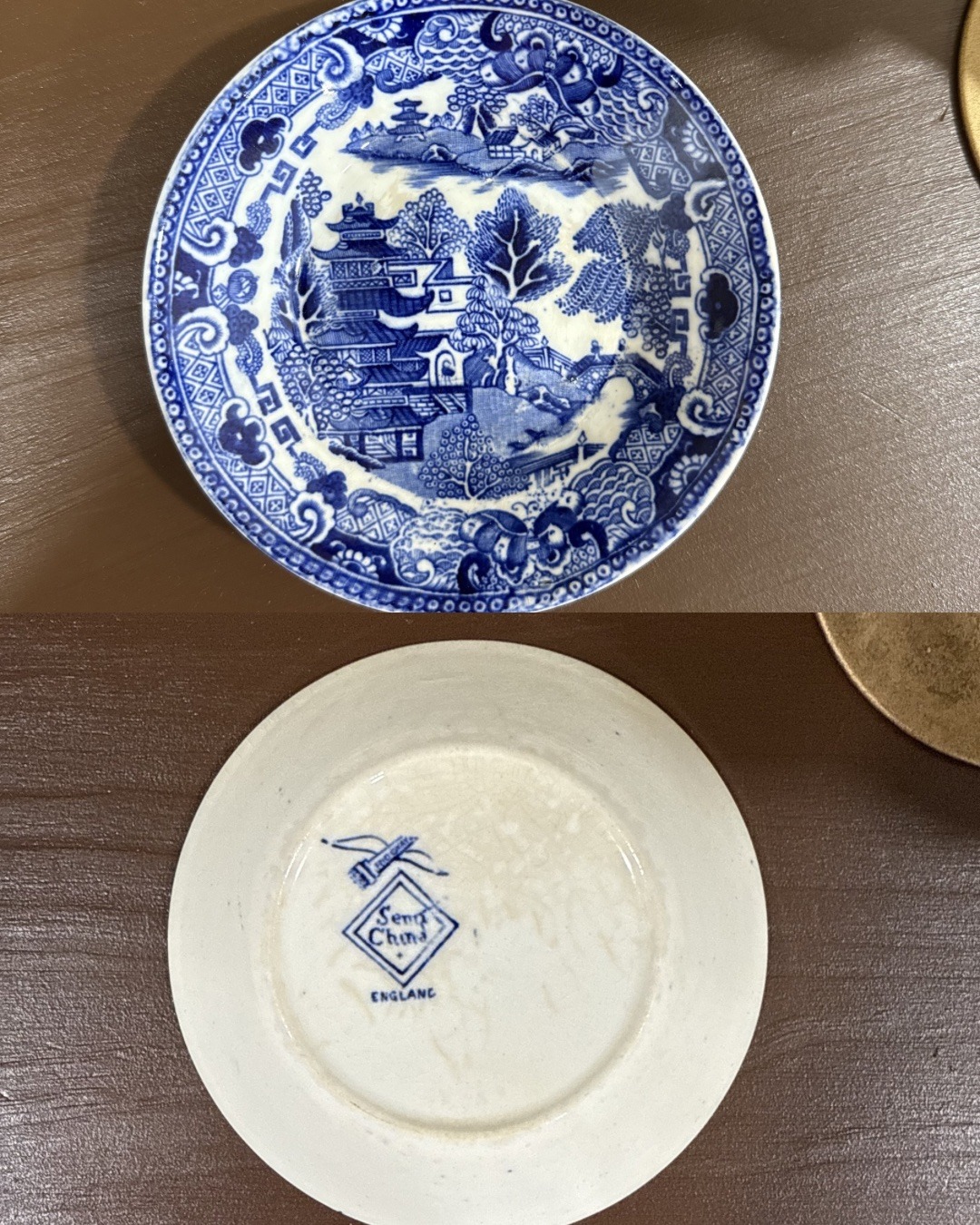
Semi-China Blue and White Willow Pattern Saucer
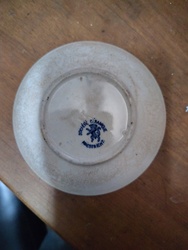
This is a circular ceramic saucer featuring a classic transfer-printed 'Willow' pattern in cobalt blue on a creamy white earthenware base. The central scene depicts traditional Chinoiserie elements, including a multi-story pagoda, stylized trees, and a bridge. The rim is decorated with a complex geometric border interspersed with floral and butterfly-like motifs. On the reverse, the piece displays a blue backstamp with a diamond-shaped mark containing the words 'Semi China' over a banner, with 'ENGLAND' printed below. The term 'Semi-China' typically refers to a durable ironstone or refined earthenware body produced by several Staffordshire potteries during the 19th and early 20th centuries. The physical condition shows significant signs of age and use; notable crazing (fine hairline cracks in the glaze) is visible across the entire underside, along with moderate brownish staining or 'tea-staining' resulting from liquid seeping through the cracked glaze into the porous ceramic body. There are small pits and kiln marks consistent with early mass-production techniques. Based on the stamping style and the 'England' country of origin mark, this piece likely dates from the late 19th century to early 20th century (circa 1891-1920).
AI-Generated Appraisal Disclaimer
Estimated Value
$15.00 - $25.00
Basic Information
Category
Antique Ceramics and Earthenware
Appraised On
April 18, 2026
Estimated Value
$15.00 - $25.00
Item Description
This is a circular ceramic saucer featuring a classic transfer-printed 'Willow' pattern in cobalt blue on a creamy white earthenware base. The central scene depicts traditional Chinoiserie elements, including a multi-story pagoda, stylized trees, and a bridge. The rim is decorated with a complex geometric border interspersed with floral and butterfly-like motifs. On the reverse, the piece displays a blue backstamp with a diamond-shaped mark containing the words 'Semi China' over a banner, with 'ENGLAND' printed below. The term 'Semi-China' typically refers to a durable ironstone or refined earthenware body produced by several Staffordshire potteries during the 19th and early 20th centuries. The physical condition shows significant signs of age and use; notable crazing (fine hairline cracks in the glaze) is visible across the entire underside, along with moderate brownish staining or 'tea-staining' resulting from liquid seeping through the cracked glaze into the porous ceramic body. There are small pits and kiln marks consistent with early mass-production techniques. Based on the stamping style and the 'England' country of origin mark, this piece likely dates from the late 19th century to early 20th century (circa 1891-1920).
Related Tags
Explore similar items and categories:
Get Your Items Appraised
Instant estimates of your treasures with AI-powered instant appraisals