AI estimate as of July 26, 2025 · verify with a professional before acting
AI-Generated · Verify before acting
Everything on this page is generated by AI for informational purposes only. AI can make mistakes — the AI may misidentify items or misattribute them (artist, maker, brand, designer, origin, era). This is not an official valuation and should not be used for insurance, sale, tax, estate, legal, or lending purposes — or any decision requiring a certified appraisal. It is not an authoritative claim about any person, brand, or rights holder — do not share or rely on it as a factual statement about a third party. Always consult qualified professionals before making financial decisions.
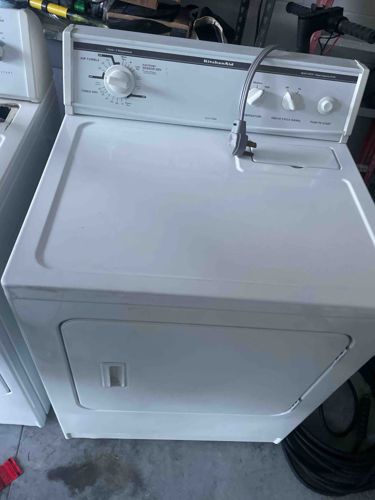
This is a white, top-loading electric clothes dryer manufactured by KitchenAid. The appliance features a rectangular, box-like body constructed primarily of white enameled metal, consistent with standard household appliance finishes. The control panel is located on the top rear of the unit, displaying various settings printed in black text on a light background. It includes a large central knob for cycle selection, labeled 'Time A Dry Control,' with options such as 'Heavy Dry,' 'Perm't Press Dry,' 'Timed Dry,' and 'Air Fluff.' To the right of the central knob are three smaller white knobs for temperature selection ('Temperature'), specific settings ('Cycle Signals'), and starting the unit ('Push To Start'). The KitchenAid brand logo is prominently displayed in black lettering on the upper right side of the control panel. The front of the dryer features a rectangular door with a recessed, integrated handle on the left side, designed for easy opening and closing. The overall condition appears to be used, with some minor scuffs or smudges visible on the white finish, typical of a well-used appliance. There's a power cord, possibly an extension or a specific dryer cord, wrapped around the top right corner of the control panel, ending in a large three-pronged plug. No significant dents or deep scratches are immediately visible, suggesting reasonable care during its service life. The design hints at a manufacturing period from the late 1990s to early 2000s, based on the control panel's aesthetic and knob styles. The construction appears sturdy, indicating a mid-range to high-end domestic appliance from its era due to the KitchenAid branding, which is known for quality home goods.
AI Appraisal Report
Upon visual examination of the provided image, I assess this KitchenAid Electric Clothes Dryer to be in good, used condition. The white enameled finish shows minor scuffs and smudges, typical wear for a well-used appliance, but no significant dents or deep scratches are visible. The control panel and knobs appear intact, suggesting functional integrity, although this cannot be confirmed without testing. Authenticity as a KitchenAid product is evident from the prominent branding.
From my assessment, this model appears to be from the late 1990s to early 2000s based on its design aesthetics and control panel style. For used home appliances of this age, market demand is generally low unless they possess unique features or are part of a rare vintage collection. Given it's a standard electric dryer, rarity is not a factor. Comparables in the secondary market for similar-aged, functional electric dryers typically range from $50 to $200, depending heavily on local market availability, condition, and the urgency of sale. While KitchenAid is a reputable brand known for quality, the unit's age significantly impacts its value due to advancements in energy efficiency and technology, as well as the inherent limited lifespan of mechanical components.
The main factors impacting value are its age, the general wear and tear, and the lack of modern features. The power cord wrapped around the top suggests it's been disconnected, implying it's not currently in use, or perhaps moved for the photo.
It is crucial to note that this appraisal is based solely on visual evidence from a single image. A physical inspection would be necessary to confirm operational status, internal component wear, and the absence of unseen damages. Testing for heating elements, motor function, drum rotation, and electrical safety would be paramount for a definitive assessment. Provenance documentation, such as original purchase receipts or service records, would also provide additional context but is not typically essential for appliance authentication. Without an in-person physical inspection and functional testing, the exact operational condition and remaining lifespan cannot be definitively determined, limiting the accuracy of the upper end of the appraisal range.