AI Appraisal Estimate

AI-generated estimates · not official valuations

From the user

What was submitted

Photo and notes provided by the user — not generated by AI

Submitted item photo
Submitted photo · June 21, 2026

User's notes

Artwork

AI analysis below

AI appraisal

AI analysis & estimate

AI-Generated · Verify before acting

Everything below is generated by AI for informational purposes only. AI can make mistakes — the AI may misidentify items or misattribute them (artist, maker, brand, designer, origin, era). This is not an official valuation and should not be used for insurance, sale, tax, estate, legal, or lending purposes — or any decision requiring a certified appraisal. It is not an authoritative claim about any person, brand, or rights holder — do not share or rely on it as a factual statement about a third party. Always consult qualified professionals before making financial decisions.

Note

This analysis also relies on unverified notes provided by the user, which may be incomplete or inaccurate and could affect the result.

Read the full disclaimer

AI Identification

·Not independently authenticated·Verify before acting

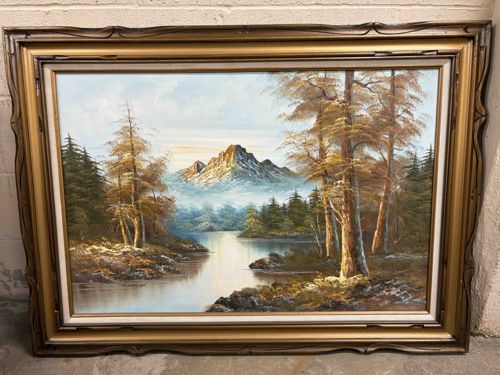
Mid-Century Alpine Landscape Oil Painting

Fine Art - Paintings

AI Estimated Value

·Not an official valuation·Verify before acting

$150 - $250

As of June 21, 2026

AI Item Analysis

·AI can make mistakes·Verify before acting
This item is a large-format horizontal oil painting on canvas depicting a serene alpine landscape. The composition features a central, snow-capped mountain peak illuminated by a soft golden light, suggesting sunrise or sunset. In the foreground, a calm body of water reflects the sky and surrounding flora. The banks are populated with a mix of evergreen and deciduous trees, primarily in shades of ochre, burnt sienna, and deep forest green, characteristic of an autumnal or late-summer palette. The technique utilizes visible brushwork and impasto in the mountain peaks to create texture and depth, indicative of typical mid-20th-century decorative art styles popular in the 1960s and 1970s. The artwork is housed in an ornate, deep-profile polychrome wooden frame with a metallic gold finish and a scalloped outer edge, featuring a secondary linen-covered inner liner to provide visual separation between the canvas and frame. The condition appears fair to good from the front, with some dust accumulation on the linen liner and minor scuffing on the frame's edges. No significant craquelure or paint loss is readily visible on the canvas surface. This piece represents a mass-marketed style of fine art intended for domestic interior decoration, often found in 'starving artist' sales or similar venues from that era.


AI Appraisal Report

·AI can make mistakes·Verify before acting
Based on my examination of the digital images and provided description, I have evaluated this large-format alpine landscape. The work is a quintessential example of mid-century decorative 'sofa art' likely produced between 1965 and 1975. The use of heavy impasto on the peaks and a warm, autumnal palette suggests it was created for mass-market domestic distribution. While the piece achieves a pleasant aesthetic effect, it lacks the technical complexity or signature of a listed gallery artist. The condition appears fair to good. I observed minor dust on the linen liner and superficial wear on the ornate gold-finished frame. The absence of visible craquelure suggests the painting has been kept in a stable environment, though the materials used in this era's mass-produced art are prone to becoming brittle over time. Market demand for this specific 'Starving Artist' genre is currently stable but modest, driven primarily by interior design trends rather than fine art investment. Comparables for mass-produced landscapes of this size typically fetch between $100 and $300 at general estate auctions. The primary value-added factor here is the substantial, ornate frame, which remains highly sought after for its decorative impact. Note that this appraisal is based solely on visual inspection of images. Full authentication would require an in-person examination of the canvas reverse to check for stamps/stretcher construction and UV fluorescence testing to identify any hidden repairs or overpainting. Provenance documentation, such as original gallery receipts or purchase records from the mid-20th century, would be necessary to elevate the piece beyond its current classification as a decorative object.

Get your items appraised

Instant estimates of your treasures with AI-powered appraisals

Browse More Appraisals