AI estimate as of August 19, 2025 · verify with a professional before acting
AI-Generated · Verify before acting
Everything on this page is generated by AI for informational purposes only. AI can make mistakes — the AI may misidentify items or misattribute them (artist, maker, brand, designer, origin, era). This is not an official valuation and should not be used for insurance, sale, tax, estate, legal, or lending purposes — or any decision requiring a certified appraisal. It is not an authoritative claim about any person, brand, or rights holder — do not share or rely on it as a factual statement about a third party. Always consult qualified professionals before making financial decisions.
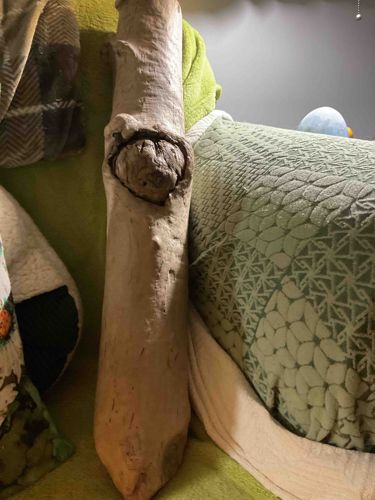
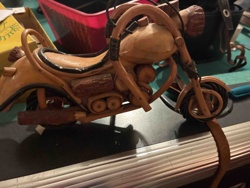
This appears to be a piece of natural driftwood or a weathered root, likely intended for decorative purposes. It is elongated and has a generally cylindrical form, tapering slightly towards one end which appears to be a natural break or cut. The wood exhibits a light, desaturated brown to grayish-tan color, indicative of significant weathering, possibly from exposure to sun and water. The surface is textured with natural imperfections, including visible wood grain, minor cracks, and small indentations. A prominent feature is a large, gnarled knot or burl located approximately one-third of the way down from the visible top. This knot creates a distinct protrusion and adds organic character to the piece. There are no discernible maker's marks, signatures, or applied finishes, suggesting its natural origin and minimal human alteration beyond possibly finding and cleaning. The condition appears to be stable, showing expected patination and wear for a natural outdoor element, but no obvious signs of recent damage, rot, or major structural compromise. Its rough, unrefined quality suggests an aesthetic aligned with rustic, coastal, or naturalistic decor. The craftsmanship is inherent to nature's processes, showcasing unique twists and forms that cannot be replicated by machinery, making each piece unique. Its estimated age is difficult to determine precisely without further analysis, but the level of weathering implies it has been exposed to elements for a considerable period, likely years or decades. The specific type of wood is not easily identifiable from the image, but its robust appearance suggests a hardwood or a sturdy conifer.
AI Appraisal Report
Based on my visual examination of the provided image, this weathered wood branch/driftwood appears to be a natural specimen, likely suited for decorative purposes. Its light, desaturated brown-to-grayish-tan color and textured surface with visible grain, minor cracks, and indentations are consistent with significant exposure to natural elements such as sun and water. The prominent gnarled knot adds significant organic character.
I confirm its authenticity as a natural wood piece based on its visual characteristics; there are no signs of artificial fabrication or alteration beyond possible cleaning. The condition appears stable, exhibiting expected patination and wear for a natural outdoor element, with no observable recent damage, rot, or major structural compromise. The 'craftsmanship' is truly nature's own, making it a unique, one-of-a-kind piece.
The market for natural decor, particularly unique driftwood or weathered wood, is niche but consistent. Comparables include artisan-crafted natural wood sculptures or large decorative driftwood pieces sold in galleries specializing in organic decor, or in high-end home furnishing stores. Demand is driven by trends in rustic, coastal, and wabi-sabi aesthetics. While not rare in the sense of a manufactured antique, the specific unique form of this piece makes it inherently uncommon. The primary factors impacting its value are its unique aesthetic appeal, size (which cannot be fully determined from the image), and excellent state of natural preservation.
My primary limitation in this assessment is the lack of physical examination. While I can confirm its natural origin visually, an in-person inspection would allow for precise measurements, tactile assessment of stability and decay, identification of wood type, and a more thorough search for any subtle alterations or signs of treatment. Provenance documentation, while unlikely for such an item, would confirm its collection history if available. Scientific testing (e.g., wood species identification) would confirm the exact type of wood. Without physical inspection, the precise dimensions and thus suitability for specific decorative placements, or its actual weight, cannot be determined.