AI estimate as of August 9, 2025 · verify with a professional before acting
AI-Generated · Verify before acting
Everything on this page is generated by AI for informational purposes only. AI can make mistakes — the AI may misidentify items or misattribute them (artist, maker, brand, designer, origin, era). This is not an official valuation and should not be used for insurance, sale, tax, estate, legal, or lending purposes — or any decision requiring a certified appraisal. It is not an authoritative claim about any person, brand, or rights holder — do not share or rely on it as a factual statement about a third party. Always consult qualified professionals before making financial decisions.
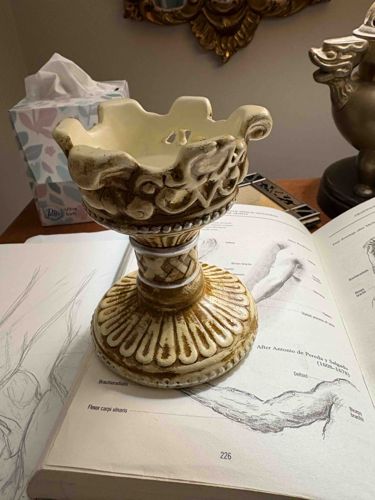
This item is a decorative ceramic goblet-shaped bowl, likely intended as an ashtray or catch-all dish, featuring a creamy off-white base color with antiqued brown accents highlighting its intricate relief details. Its physical characteristics include a wide, scalloped rim atop a bowl, supported by a central stem, which then flares out to a circular, footed base. The overall construction appears to be molded ceramic. The bowl itself has four distinct, deep indentations on its rim, suggesting its primary function might have been an ashtray for cigarettes, or possibly for resting small utensils or decorative objects. The surface of the bowl has a smooth, glazed finish. The exterior of the bowl is adorned with an ornate, scrolling leaf or floral motif in raised relief, emphasizing its classical or baroque-inspired design. The stem of the goblet exhibits a braided or woven pattern in relief, continuing the intricate detailing. The circular base is decorated with a series of petal-like or fluted segments radiating outwards from the center, complementing the overall decorative scheme. The brown antiquing is particularly noticeable in the recessed areas, providing depth and an aged appearance. The visible condition includes some minor discoloration and possible dirt accumulation within the crevices, consistent with typical use and age. There are no obvious chips, cracks, or repairs visible from this perspective, suggesting a relatively good state of preservation. The craftsmanship appears to be commercially produced, possibly from the mid-20th century, given its aesthetic and common manufacturing techniques of that era, though definite dating without a maker's mark is speculative. Its design suggests it was created as a decorative accent piece, possibly with a utilitarian function.
AI Appraisal Report
I have examined the provided image of the Antiqued Ceramic Goblet-Shaped Bowl. Based on visual inspection, its condition appears to be relatively good, with no obvious chips, cracks, or repairs. The minor discoloration and dirt accumulation are consistent with age and use. Authenticity as a commercially-produced decorative item from the mid-20th century seems plausible given its design and manufacturing style. Market conditions for such decorative ceramic pieces are moderate. While the piece is aesthetically pleasing with its intricate relief and antiqued finish, it falls into a broad category of mass-produced decorative arts. Comparables would include similar ceramic ashtrays, catch-all dishes, or decorative centerpieces from the mid-century period. Demand for these items is generally stable but not exceptionally strong, unless attributed to a well-known designer or manufacturer, which is not indicated here. The rarity is low; countless similar items were produced. Factors impacting value significantly include its lack of a maker's mark (preventing identification of a potentially desirable manufacturer) and its common design. Its primary value is decorative. For full authentication and to ascertain whether there is any specific value beyond common decorative arts, an in-person examination would be crucial to look for hidden marks, assess the ceramic quality more thoroughly, and confirm manufacturing techniques. Provenance documentation, if available, could also significantly impact value by linking it to a specific designer, event, or collection.