These notes were written by the person who submitted this item. Appraiser.AI has not verified them, and the AI's identification and estimate may rely on them.
AI Estimated Value
Not an official valuation
$45-75
AI estimate as of August 2, 2025 · verify with a professional before acting
AI-Generated · Verify before acting
Everything on this page is generated by AI for informational purposes only. AI can make mistakes — the AI may misidentify items or misattribute them (artist, maker, brand, designer, origin, era). This is not an official valuation and should not be used for insurance, sale, tax, estate, legal, or lending purposes — or any decision requiring a certified appraisal. It is not an authoritative claim about any person, brand, or rights holder — do not share or rely on it as a factual statement about a third party. Always consult qualified professionals before making financial decisions.
This analysis also relies on unverified notes provided by the user, which may be incomplete or inaccurate and could affect the result.
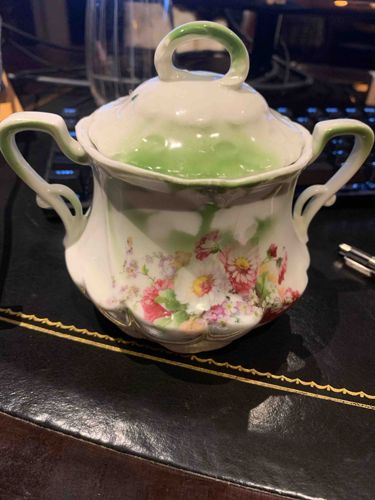
This is a vintage porcelain covered sugar bowl, likely part of a tea or coffee set. Its physical characteristics include a classic, somewhat bulbous body with a fluted or scalloped base, giving it an ornate profile. The material is white porcelain, which appears to be finely crafted, suggesting good quality. The primary color palette combines pristine white with a vibrant, glossy light green glaze applied to the upper rim and handles of both the bowl and its lid. The handles themselves are elegantly looped, with a double-curve design that offers both aesthetic appeal and a practical grip.
The most notable feature is the hand-painted floral decoration on the body of the bowl. The vibrant bouquet includes various flowers, predominantly white and pink daisies or similar blossoms, with accents of red, purple, and yellow, surrounded by green foliage. The painting style appears to be soft and watercolorsque, allowing for blending and delicate transitions of color. The lid is also fluted and fits snugly, topped with a matching looped handle, again glazed in light green.
Visible condition issues include what appears to be some minor wear to the green glaze on the handles and lid rim, consistent with age and use. There are no obvious chips, cracks, or significant repairs visible in the provided image; however, a more thorough inspection would be required for a definitive assessment. The craftsmanship suggests attention to detail, particularly in the hand-painting and the shaping of the porcelain. The 'Germany 66' stamp, if it refers to the year, places its manufacturing date in 1966, indicating it as mid-20th century. If '66' is a model or pattern number, it would still likely be a mid-century piece given the style and common manufacturing practices of the period. This piece embodies a charming, somewhat romantic aesthetic, typical of European porcelain ware from that era.
AI Appraisal Report
This vintage porcelain covered sugar bowl, stamped "Germany 66," presents as a charming example of mid-20th century European porcelain. The white porcelain body, adorned with a vibrant hand-painted floral design and light green glazed accents, exhibits good craftsmanship.
Upon visual inspection, the overall condition appears good for its age. I note minor wear to the green glaze on the handles and lid rim, consistent with typical use and handling over decades. Crucially, I observe no obvious chips, cracks, or significant repairs that would drastically diminish its value. The 'watercolorsque' floral painting is appealing, and the fluted design adds to its decorative quality.
The "Germany 66" stamp is intriguing. If '66' indicates the year 1966, it firmly places the item in the mid-century period, aligning with its aesthetic. If it's a mold or pattern number, the style still strongly suggests a mid-20th century origin. This designation, combined with the hand-painted decor, places it in a desirable category for collectors of vintage European decorative arts.
Market conditions for such pieces are generally stable. While not exceptionally rare, good quality, well-preserved examples with attractive hand-painting like this maintain a steady demand among collectors of vintage serveware, particularly those assembling tea sets or seeking decorative accents. Comparables typically range based on the artistry of the painting, the condition, and the reputation of the maker, though "Germany" marks often pertain to smaller, regional factories or export pieces. The lack of a specific manufacturer's mark limits its top-tier collectible status but does not preclude its decorative and functional value.
Factors impacting value positively include its good apparent condition, the detailed hand-painting, and its appeal as a functional and decorative item. Without a confirmed maker, uniqueness is tied more to the artistic execution than rarity of the brand.
My primary limitation in this appraisal is the lack of a physical examination. While the image provides a good overview, an in-person inspection would be essential to confirm the extent of glaze wear, detect any hairline cracks or chips not visible in photographs, and precisely assess the quality and technique of the hand-painting. Furthermore, determining whether '66' is a date or a pattern number would require more extensive research into German porcelain marks from that period, potentially involving physical hallmark guides or expert opinions on specific manufacturer practices. True authenticity of original paint and non-repair requires tactile and magnified inspection.