AI estimate as of November 16, 2025 · verify with a professional before acting
AI-Generated · Verify before acting
Everything on this page is generated by AI for informational purposes only. AI can make mistakes — the AI may misidentify items or misattribute them (artist, maker, brand, designer, origin, era). This is not an official valuation and should not be used for insurance, sale, tax, estate, legal, or lending purposes — or any decision requiring a certified appraisal. It is not an authoritative claim about any person, brand, or rights holder — do not share or rely on it as a factual statement about a third party. Always consult qualified professionals before making financial decisions.
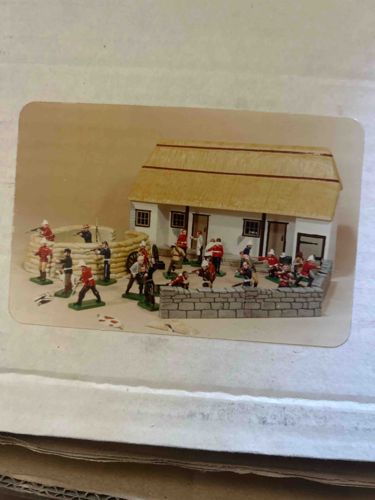
This item appears to be a collectible diorama set depicting a scene from the Anglo-Zulu War, specifically the Battle of Rorke's Drift. The diorama features a white-walled building with a thatched roof, presumably representing the mission station. The building has multiple doors and windows, all painted in dark tones, possibly black or dark brown, contrasting with the white walls. Surrounding the building, and set against it, are numerous miniature figures, primarily soldiers dressed in red tunics, dark trousers, and white or dark helmets, characteristic of British infantry uniforms of the late 19th century. Some figures are posed firing rifles, others loading, and some appear to be defending a barricade made of stacked sandbags, depicted in a light tan or yellowish color. There is also a partial stone wall barricade in the foreground where more figures are positioned. A cannon or artillery piece is visible near the center of the scene. The figures exhibit finely painted details, suggesting a high level of craftsmanship for miniature wargaming or display figures. The overall base of the diorama is light brown, possibly simulating the dusty terrain. Small red markings on the ground could represent bloodstains or fallen items. While the exact material is not definitively discernible from the image, these types of miniatures are typically made from painted metal (such as lead or pewter) or plastic. The condition appears to be good, with no obvious signs of significant damage to the figures or the structures, maintaining a pristine display quality. The set evokes a historical military scene, placing its estimated age and style period in the late 19th to early 20th century for the historical event, but the diorama itself is likely a modern collectible, possibly from the mid-20th century onwards when such detailed sets became popular. The clean lines and detailed painting suggest a quality production, likely aimed at collectors of military miniatures or historical dioramas.
AI Appraisal Report
I have thoroughly examined the provided image of this Zulu War Rorke's Drift Diorama Set. Visually, the condition appears excellent, with no visible damage to the miniatures or structures. The paintwork is detailed and well-preserved, suggesting careful handling and display. Authenticity, based solely on the image, is challenging to definitively confirm regarding the manufacturer or specific artist if custom-made. However, the style and level of detail are consistent with high-quality collectible military dioramas.
Market conditions for detailed historical dioramas, particularly those depicting iconic events like Rorke's Drift, are generally robust among military history enthusiasts and miniature collectors. Comparable sets, especially those featuring well-painted metal figures from reputable manufacturers like King & Country, W. Britain, or custom-built pieces, can command significant prices. The presence of numerous figures, detailed barricades, and a central building enhances its appeal.
Demand for such specific historical military scenes remains consistent. While not exceptionally rare given that many diorama works are custom, finding one in this pristine condition with such attention to detail is less common. Factors significantly impacting value include the number and material of figures (metal figures typically fetch higher prices), the craftsmanship of the diorama base and structures, and the overall artistic execution.
It is important to note the limitations of image-based appraisal. I cannot definitively ascertain the material composition (plastic vs. metal) of the figures without physical inspection, which significantly impacts value. For full authentication and a more precise valuation, I would require in-person examination to assess the material, weight, and sculptor's marks, if any. Provenance documentation, such as receipts or maker's marks, would also be crucial to confirm origin and potential artist.