Art Nouveau Style Vienna Regulator Wall Clock
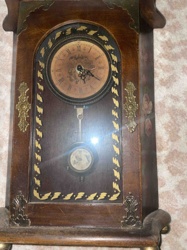
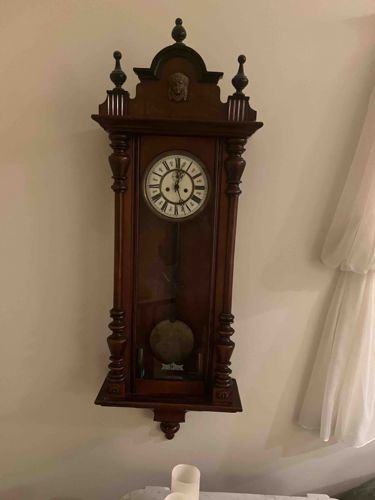
This is a tall, slender wall clock featuring a dark wood case, likely walnut or mahogany, with a rich reddish-brown finish. The clock follows the Vienna Regulator style, characterized by its vertical orientation and architectural pediment. At the top, the pediment is decorated with a carved female face or mask in high relief, flanked by turned finials. The case features decorative turned columns or pilasters on either side of the glass-fronted door. Inside, a two-part white enamel dial is visible with black Roman numerals and slender black hands, and two winding holes. Below the dial, a long pendulum with a circular brass or metal bob is visible through the glass pane. The base of the clock terminates in a decorative drop with a final turned finial. The overall craftsmanship suggests a late 19th-century or early 20th-century production. Condition appears fair with some visible aging to the wood finish and typical oxidation on the metal components like the pendulum bob. The glass appears intact, and the overall structure seems stable.
AI-Generated Appraisal Disclaimer
Estimated Value
$600 - $900
Basic Information
Category
Antiques & Collectibles - Horology
Appraised On
March 1, 2026
Estimated Value
$600 - $900
Item Description
This is a tall, slender wall clock featuring a dark wood case, likely walnut or mahogany, with a rich reddish-brown finish. The clock follows the Vienna Regulator style, characterized by its vertical orientation and architectural pediment. At the top, the pediment is decorated with a carved female face or mask in high relief, flanked by turned finials. The case features decorative turned columns or pilasters on either side of the glass-fronted door. Inside, a two-part white enamel dial is visible with black Roman numerals and slender black hands, and two winding holes. Below the dial, a long pendulum with a circular brass or metal bob is visible through the glass pane. The base of the clock terminates in a decorative drop with a final turned finial. The overall craftsmanship suggests a late 19th-century or early 20th-century production. Condition appears fair with some visible aging to the wood finish and typical oxidation on the metal components like the pendulum bob. The glass appears intact, and the overall structure seems stable.
Get Your Items Appraised
Instant estimates of your treasures with AI-powered instant appraisals