These notes were written by the person who submitted this item. Appraiser.AI has not verified them, and the AI's identification and estimate may rely on them.
AI Estimated Value
Not an official valuation
$75-125
AI estimate as of July 18, 2025 · verify with a professional before acting
AI-Generated · Verify before acting
Everything on this page is generated by AI for informational purposes only. AI can make mistakes — the AI may misidentify items or misattribute them (artist, maker, brand, designer, origin, era). This is not an official valuation and should not be used for insurance, sale, tax, estate, legal, or lending purposes — or any decision requiring a certified appraisal. It is not an authoritative claim about any person, brand, or rights holder — do not share or rely on it as a factual statement about a third party. Always consult qualified professionals before making financial decisions.
This analysis also relies on unverified notes provided by the user, which may be incomplete or inaccurate and could affect the result.
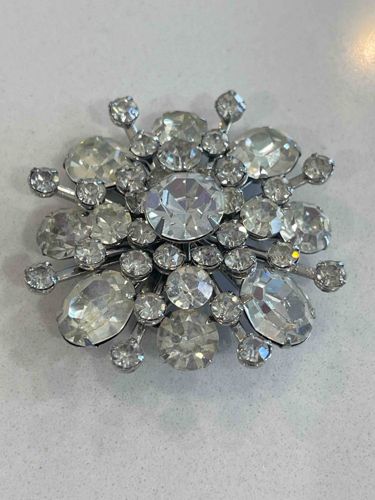
This is a vintage or antique brooch, likely a costume jewelry piece given the abundance of clear, faceted stones which appear to be rhinestones or paste rather than genuine diamonds. The brooch features a circular, possibly floral or starburst, design composed of numerous clear, colorless stones set in a silver-toned metal. The central stone is a large, round faceted rhinestone, surrounded by a symmetrical arrangement of smaller, similarly cut round stones and several larger, oval-shaped stones. These stones are held in place by multi-prong settings, indicative of good craftsmanship for costume jewelry, ensuring each stone is securely mounted. The metal setting appears to be a rhodium-plated base metal or pot metal due to its bright, untarnished silver appearance and smooth finish. Some of the smaller stones are set on elevated prongs or bars, creating a three-dimensional, layered effect, adding depth and sparkle to the piece. There are no immediately visible condition issues such as missing stones, significant scratches, or heavy discoloration on the metal, though a faint yellow reflection is seen on one oval stone, suggesting light glinting off its surface rather than damage. No maker's marks or signatures are visible from this top-down view. The design style, with its clustered and elevated stones, suggests a mid-20th century aesthetic, perhaps from the 1940s to 1960s. The overall quality of the sparkle from the rhinestones is high, indicating good quality glass or crystal stones designed to mimic diamonds. The craftsmanship indicates thoughtful arrangement of stones to maximize brilliance and visual impact.
AI Appraisal Report
I have carefully examined the provided image of this Vintage Rhinestone Starburst Brooch. Based on its appearance, this is a beautiful example of mid-20th century costume jewelry. The abundance of clear, faceted stones, which appear to be high-quality rhinestones or paste, confirms it is not genuine diamond jewelry. The silver-toned metal setting, likely rhodium-plated base metal, is consistent with such pieces from the 1940s-1960s. The multi-prong settings and elevated stone arrangement demonstrate good craftsmanship, creating a desirable three-dimensional effect and maximizing sparkle. Visually, the condition appears excellent; no missing stones, significant scratches, or metal discoloration are evident from this angle, which positively impacts its value.
In terms of market conditions, vintage costume jewelry, especially well-preserved pieces with a strong visual appeal like this, has a steady collector's market. While not rare, the quality of this particular piece makes it more desirable than average. Comparables in the market for similar high-quality, brilliant rhinestone brooches from this era typically range from \"good\" to \"very good\" condition. The lack of visible maker's marks is common for this type of jewelry and does not significantly detract from its value unless it were a piece by a highly sought-after, signed designer (e.g., Haskell, Trifari, etc.). Without a signature, its value is based primarily on aesthetic appeal and condition.
It is important to note that this assessment is based solely on the provided image. A definitive authenticity verification would require in-person examination to confirm stone material (glass vs. crystal), assess the true condition of the metal and fastenings, and search for hidden maker's marks. Physical inspection would also allow for a more precise evaluation of wear and tear not visible in photographs. Provenance documentation, if available, could add historical context but is not typically critical for this type of item.