These notes were written by the person who submitted this item. Appraiser.AI has not verified them, and the AI's identification and estimate may rely on them.
AI Estimated Value
Not an official valuation
$100-200
AI estimate as of July 29, 2025 · verify with a professional before acting
AI-Generated · Verify before acting
Everything on this page is generated by AI for informational purposes only. AI can make mistakes — the AI may misidentify items or misattribute them (artist, maker, brand, designer, origin, era). This is not an official valuation and should not be used for insurance, sale, tax, estate, legal, or lending purposes — or any decision requiring a certified appraisal. It is not an authoritative claim about any person, brand, or rights holder — do not share or rely on it as a factual statement about a third party. Always consult qualified professionals before making financial decisions.
This analysis also relies on unverified notes provided by the user, which may be incomplete or inaccurate and could affect the result.
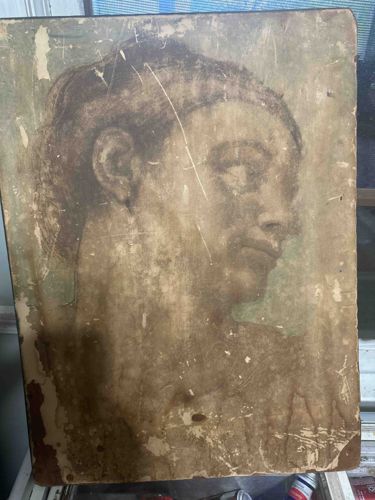
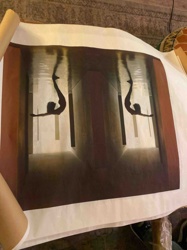
This item is an antique or vintage drawing, possibly a study or sketch, rendered in a monochromatic palette on what appears to be a heavy paper, board, or even a very thin canvas mounted to a rigid support. The primary subject is a profile portrait of a male figure, resembling early classical or Renaissance depictions of Adam, though the details are somewhat obscured by significant wear. The drawing technique suggests charcoal, conté crayon, or perhaps a sepia wash, utilizing shading and highlights to define the form. The colors are muted, primarily in earth tones of browns and grays, with hints of a faded greenish or turquoise hue in the background, suggesting a subtle use of color or discoloration over time.
The physical characteristics reveal a rectangular format. The surface exhibits extensive condition issues, including numerous scratches, scuffs, and abrasions, particularly noticeable as white lines across the dark tones, indicative of surface loss. There are also darker smudges and what appear to be water stains or general discoloration, especially along the bottom and left edges. The edges of the support itself show signs of wear and chipping. The overall appearance suggests significant age and exposure to elements, possibly having been stored inadequately. No discernible maker's marks, signatures, or stamps are visible in the provided images. The style indicates a classical academic approach to figural drawing, potentially from the 19th or early 20th century. Despite the condition, the underlying draughtsmanship appears competent, showcasing an understanding of human anatomy and form. The quality is indicative of a student's work from a formal art education or an artist's study.
AI Appraisal Report
I have examined the provided image of the "Profile Study of a Male Figure (Adam)," a drawing rendered in monochromatic tones, likely charcoal or cont
crayon, on what appears to be a rigid support. Its style strongly points to a classical academic approach, suggesting a 19th or early 20th-century origin, possibly as a student's study or an artist's personal work. The underlying draughtsmanship is competent, demonstrating an understanding of anatomy and form.
Condition is the primary factor significantly impacting this item's value. The drawing exhibits extensive wear, including numerous scratches, scuffs, abrasions, dark smudges, and what appear to be water stains, especially along the bottom and left edges. The support itself shows chipping and wear, indicative of age and inadequate storage. These condition issues severely detract from its aesthetic appeal and marketability.
From the image alone, definitive authenticity verification is impossible. The absence of discernible maker's marks, signatures, or stamps prevents attribution. For full authentication, an in-person examination would be crucial to assess the medium, paper/support type, and exact nature of the damage. Provenance documentation, if available, would be invaluable. Scientific testing, such as pigment analysis or carbon dating, could further confirm the age.
Based on current market conditions for unauthenticated, unsigned classical academic studies in significantly compromised condition, demand is limited. While the subject matter is classic, the lack of attribution and poor condition place it outside the realm of high-value fine art. Comparable unsigned, heavily damaged academic studies typically fetch low prices. Demand exists primarily among collectors of antique drawings or decorative items rather than serious fine art collectors.
Given these considerations, particularly the pervasive condition issues and lack of attribution, the value is primarily decorative.