AI estimate as of September 8, 2025 · verify with a professional before acting
AI-Generated · Verify before acting
Everything on this page is generated by AI for informational purposes only. AI can make mistakes — the AI may misidentify items or misattribute them (artist, maker, brand, designer, origin, era). This is not an official valuation and should not be used for insurance, sale, tax, estate, legal, or lending purposes — or any decision requiring a certified appraisal. It is not an authoritative claim about any person, brand, or rights holder — do not share or rely on it as a factual statement about a third party. Always consult qualified professionals before making financial decisions.
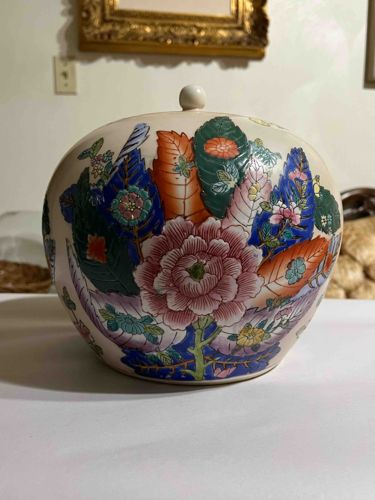
This appears to be a porcelain ginger jar with a lid, decorated in a vibrant 'Famille Rose' (or akin) palette. The jar itself has a rounded, squat body and is topped with a simple domed lid featuring a small, round finial. The primary color of the porcelain body is a light, possibly off-white or cream, serving as a clean canvas for the extensive floral and foliate decoration. The decoration features large, lush blossoms, most notably a prominent pink peony in the foreground, surrounded by an array of colorful leaves in shades of orange, deep blue, green, and purple, along with smaller blossoms and delicate tendrils. The colors are rich and opaque, characteristic of overglaze enamels. The brushwork appears deliberate and detailed, showcasing good craftsmanship in the application of the intricate design. There are no visible chips, cracks, or significant wear marks, suggesting it is in good, well-preserved condition. The surface has a soft sheen consistent with glazed porcelain. Without a view of the base, it's hard to discern specific manufacturer marks or signatures, which would typically indicate origin and precise age. However, the style strongly suggests an Asian, likely Chinese, origin, and the 'Famille Rose' style was popular from the 18th century onwards, with modern reproductions also common. The quality of the hand-painted decoration suggests it is not a mass-produced decal item, but rather a hand-decorated piece, indicating a higher quality of craftsmanship. No obvious repairs are visible, and the overall appearance is clean and intact.
AI Appraisal Report
Upon my virtual examination of this Famille Rose Style Porcelain Ginger Jar, I find its overall condition to be excellent, with no visible chips, cracks, or significant wear. The vibrant, hand-painted floral and foliate decoration, characteristic of the Famille Rose palette, showcases a good level of craftsmanship, suggesting it's not a mass-produced decal. The rich opacity of the enamels and the detailed brushwork contribute to its aesthetic appeal.
Assessing authenticity purely from images presents limitations. While the style strongly points to an Asian, likely Chinese, origin, and the Famille Rose style has a long history, distinguishing between genuine antique pieces, 20th-century reproductions, or more modern decorative items is challenging without physical inspection. Many reproductions mimic older styles convincingly. Given the clear, bright colors and apparent lack of significant age-related patination or wear often found on older pieces, I lean towards this being a high-quality decorative piece from the mid-to-late 20th century or early 21st century rather than an antique example.
In terms of market conditions, while true antique Famille Rose porcelain can command high prices, modern decorative pieces, even high-quality ones, are more common. Comparables in the current market for similar well-executed, decorative Famille Rose style ginger jars (without definitive antique attribution) typically fall into the $250-$450 range. Demand for such decorative items is consistent for home decor, but rarity is low for non-antique pieces.
Factors impacting value significantly include definitive age attributions, provenance, and the potential identification of a specific kiln or artist. For full authentication and to ascertain a more precise age, a physical examination would be crucial to assess the porcelain body's paste, glaze characteristics, foot rim finish, and any maker's marks on the base. Provenance documentation, such as receipts or exhibition history, would also greatly aid in verification.