These notes were written by the person who submitted this item. Appraiser.AI has not verified them, and the AI's identification and estimate may rely on them.
AI Estimated Value
Not an official valuation
$600-900
AI estimate as of September 15, 2025 · verify with a professional before acting
AI-Generated · Verify before acting
Everything on this page is generated by AI for informational purposes only. AI can make mistakes — the AI may misidentify items or misattribute them (artist, maker, brand, designer, origin, era). This is not an official valuation and should not be used for insurance, sale, tax, estate, legal, or lending purposes — or any decision requiring a certified appraisal. It is not an authoritative claim about any person, brand, or rights holder — do not share or rely on it as a factual statement about a third party. Always consult qualified professionals before making financial decisions.
This analysis also relies on unverified notes provided by the user, which may be incomplete or inaccurate and could affect the result.
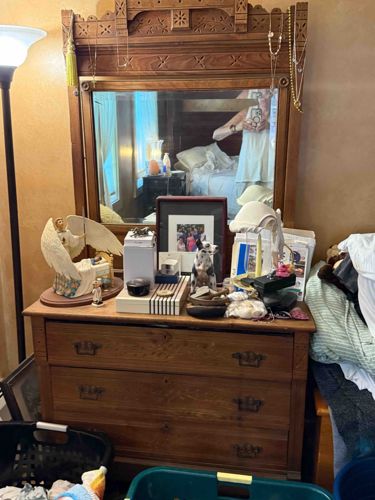
This is a substantial dresser with an integrated mirror, likely dating from the late Victorian or early Edwardian period (approximately 1890s-1910s). It is constructed from a medium-to-dark stained wood, possibly oak given the visible grain, though the exact wood species isn't definitively identifiable from the image. The dresser features three full-width drawers stacked vertically, each adorned with ornate, possibly brass or bronze, bail pull and escutcheon hardware with a stylized, almost floral or classic motif. The surface of the dresser top is covered with numerous personal items, suggesting active use. The most striking feature of this piece is the large, rectangular mirror attached to the back of the dresser. The mirror's frame is highly decorative, with extensive carving along its top and sides. The carved elements include geometric patterns, stylized flora, and possible rosettes, indicating a Gothic Revival or Aesthetic Movement influence. A prominent, carved pediment-like element extends above the mirror, further enhancing its vertical presence and decorative flair. Tassels and necklaces are hung from the carved frame, suggesting it is being utilized as a functional piece within a bedroom setting. The overall condition appears consistent with its age, showing a rich patina. No significant damage or repairs are immediately visible, though close inspection would be required to ascertain any wear, scratches, or nicks. The mirror itself seems largely intact, reflecting the room behind it clearly. The heavy, robust construction points to quality craftsmanship typical of the era.
AI Appraisal Report
Based on my visual examination of the provided image, this Victorian/Edwardian era dresser with an integrated carved mirror presents as a well-preserved piece, likely dating from the 1890s-1910s. The construction appears robust, indicative of the quality craftsmanship typical of the period. While the wood grain suggests oak, a definitive identification of the wood species is not possible without an in-person inspection. The ornate bail pull and escutcheon hardware are consistent with the era. The most significant feature is the extensively carved mirror frame, displaying elements of Gothic Revival or Aesthetic influence, which adds considerable decorative appeal. The overall condition appears good, with a rich patina developed over time. I do not observe any significant damage, repairs, or structural issues from the image, but minor wear, scratches, or nicks would require direct physical examination.
In terms of authenticity, the design, hardware, and construction style strongly align with the late Victorian/early Edwardian period. However, verifying the originality of all components, particularly the hardware and mirror glass, without an in-person inspection is limited. Market conditions for antique furniture, while not as robust as in past decades, show continued demand for well-maintained, aesthetically pleasing pieces with distinctive features like this carved mirror. Comparables for similar quality dressers from this era with elaborate carvings typically range from $600 to $1,200, depending heavily on condition, wood type, and specific market. The integrated and decorative mirror elevates its value beyond a plain dresser. The functional use suggested by the personal items on top and hanging from the mirror indicates it's a cherished piece.
Key factors impacting value include the excellent apparent condition, the intricate carving, and the overall period authenticity. The primary limitation in this appraisal is the lack of a physical examination. To provide a full authentication, I would need to inspect the piece for any hidden repairs, verify the wood species definitively, and assess the originality of all hardware and the mirror itself. Scientific testing could be used for wood identification, but is generally not undertaken for pieces of this value unless originality is in question. Provenance documentation, such as original sales receipts or family history, would further enhance authentication, though it's often unavailable for items of this age.