AI estimate as of June 27, 2025 · verify with a professional before acting
AI-Generated · Verify before acting
Everything on this page is generated by AI for informational purposes only. AI can make mistakes — the AI may misidentify items or misattribute them (artist, maker, brand, designer, origin, era). This is not an official valuation and should not be used for insurance, sale, tax, estate, legal, or lending purposes — or any decision requiring a certified appraisal. It is not an authoritative claim about any person, brand, or rights holder — do not share or rely on it as a factual statement about a third party. Always consult qualified professionals before making financial decisions.
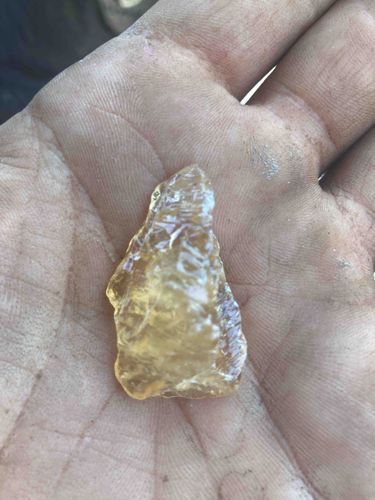
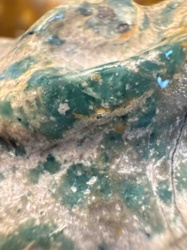
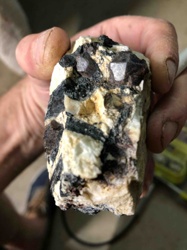
The item is a raw, unfaceted chunk of what appears to be a transparent to translucent mineral, possibly a form of quartz like citrine or possibly amber due to its golden-yellow to brownish-orange coloration. It exhibits an irregular, unpolished shape with multiple natural cleavage planes and fracture surfaces that reflect light in various directions, indicating a crystalline structure or conchoidal fracture pattern typical of glass or certain minerals. The surfaces vary from relatively smooth and lustrous to more rough and pitted. Its size appears small, fitting comfortably within the palm of a hand, suggesting it is likely less than an inch or two in its largest dimension. There are no discernible manufacturing marks, inclusions, or specific identifying features that would conclusively determine its exact mineralogy from the image alone. The color is rich and warm, though the transparency and light refraction suggest it's not entirely opaque. There are no obvious signs of wear, damage, or repairs, as its current state appears to be its natural, unworked form. Its age is indeterminate without further analysis, as it is a natural material. The quality is typical of a raw, unrefined specimen, with its value largely depending on its specific mineral identification, clarity, and potential for cutting or polishing.
AI Appraisal Report
I have carefully examined the image of this unpolished golden translucent mineral specimen. Based on visual assessment, its condition appears to be excellent, typical of a natural, unworked mineral chunk. The multiple facets and fracture planes suggest a beautiful interplay with light, indicating good transparency or translucency. Authenticity, based solely on this image, leans toward it being a natural mineral. However, a definitive determination of its exact mineralogy (e.g., quartz, amber, or even glass) is impossible without direct physical examination.
The market for raw mineral specimens is driven by factors such as clarity, color saturation, crystal habit, and rarity of the specific mineral. Given its warm golden hue and apparent translucency, if this were high-quality citrine or amber, it would hold good value. However, without a definitive identification, its current market position is speculative. Comparables would range from low-value common quartz specimens to higher-value amber or specialty minerals, but without identification, no precise comparable can be drawn.
Factors significantly impacting value include its true identity (mineral species), optical clarity, potential for facetting (if it's a gem material), and size. Its small size, appearing less than 2 inches in its largest dimension, limits its intrinsic value as a large display piece.
Crucially, authentication is severely limited by image-only review. To fully authenticate and accurately value this specimen, an in-person physical examination is essential. This would involve inspecting tactile properties, density, hardness testing, and potentially refractive index measurements. For definitive identification, laboratory analysis such as spectroscopy (e.g., IR spectroscopy for organic materials like amber, or X-ray diffraction for crystalline structures) would be required. Without such direct examination and testing, it is impossible to distinguish it conclusively from a common, low-value mineral or even well-colored glass.