AI estimate as of August 31, 2025 · verify with a professional before acting
AI-Generated · Verify before acting
Everything on this page is generated by AI for informational purposes only. AI can make mistakes — the AI may misidentify items or misattribute them (artist, maker, brand, designer, origin, era). This is not an official valuation and should not be used for insurance, sale, tax, estate, legal, or lending purposes — or any decision requiring a certified appraisal. It is not an authoritative claim about any person, brand, or rights holder — do not share or rely on it as a factual statement about a third party. Always consult qualified professionals before making financial decisions.
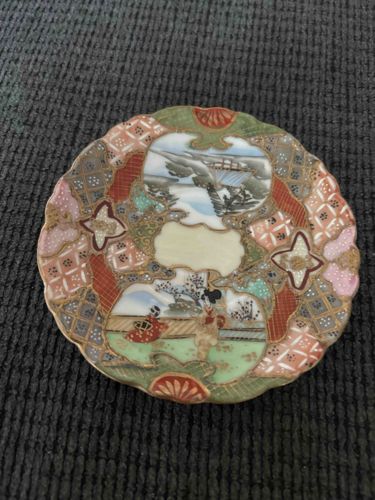
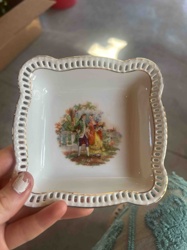
This is a small, possibly Japanese, decorative plate or coaster, characterized by its intricate, multicolored enameling and scalloped edge. The physical characteristics indicate a ceramic-like material, likely porcelain or earthenware, given the fine detail and painted surface. The diameter appears to be approximately 3-5 inches based on typical coaster/small plate sizes. The color palette is rich, featuring greens, reds, blues, pinks, browns, and gold accents. The surface is highly decorated with distinct panels. There are two main pictorial panels: one depicting a serene landscape with mountains, possibly a bridge, and snow or clouds; the other shows figures, likely geishas or similar historical Japanese individuals, in a garden or natural setting. These scenes are enclosed within ornate borders. Surrounding these central scenes are sections with geometric patterns, including diamond lattice work and floral motifs, all rendered in vibrant enamels with delicate gold outlines. Several star-shaped or quatrefoil elements are interspersed, also finely decorated. A central, blank cartouche shape suggests a space meant for an inscription or monogram, though it is currently empty. The level of detail and precision in the painting indicates quality craftsmanship. There are no obvious signs of significant damage like chips, cracks, or repairs, but a slight patina and some subtle wear to the gold accents might be present consistent with age. Without a visible maker's mark, discerning the exact manufacturing details is challenging, but the style strongly suggests a Japanese origin, possibly dating from the late 19th to early 20th century, consistent with Satsuma or Imari porcelain styles that often feature such detailed scenes and rich enamels.
AI Appraisal Report
Based on my visual examination of the provided image, this decorative enamel plate/coaster exhibits characteristics consistent with Japanese decorative arts, likely late 19th to early 20th century. The intricate multicolored enameling, scalloped edge, and detailed pictorial panels (landscape and figural scenes), along with geometric and floral motifs, strongly suggest a Japanese origin, possibly akin to Satsuma or Imari ware in style, though without a visible mark, this is an attribution based purely on aesthetics.
The condition appears excellent from the image, with no obvious chips, cracks, or repairs. A slight patina and potential minor wear to gold accents are expected given its probable age. The level of detail and precision indicates quality craftsmanship.
Market conditions for such pieces are generally stable but not experiencing significant surges. Comparables include other small Japanese decorative plates of similar age and quality. Demand exists among collectors of Asian decorative arts, but it's not exceptionally rare within the broader antique market.
Factors impacting value include the lack of a maker's mark, which significantly limits definitive attribution and provenance. While the style is compelling, without a known artist or workshop, its value is primarily decorative rather than historical or artistic. The 'blank cartouche' could have been for inscription, but its emptiness doesn't detract significantly unless it was intended for something specific.
Limitation in authenticity verification from images alone is considerable. Full authentication would require in-person examination to assess the exact ceramic body, enamel thickness, and true gold application. Provenance documentation (previous ownership) would be crucial for a definitive historical attribution. Scientific testing of materials (e.g., pigment analysis) could further confirm age and origin.