AI Appraisal Estimate

AI-generated estimates · not official valuations

From the user

What was submitted

Photo and notes provided by the user — not generated by AI

Submitted item photo
Submitted photo · May 27, 2026

User's notes

Good condition

AI analysis below

AI appraisal

AI analysis & estimate

AI-Generated · Verify before acting

Everything below is generated by AI for informational purposes only. AI can make mistakes — the AI may misidentify items or misattribute them (artist, maker, brand, designer, origin, era). This is not an official valuation and should not be used for insurance, sale, tax, estate, legal, or lending purposes — or any decision requiring a certified appraisal. It is not an authoritative claim about any person, brand, or rights holder — do not share or rely on it as a factual statement about a third party. Always consult qualified professionals before making financial decisions.

Note

This analysis also relies on unverified notes provided by the user, which may be incomplete or inaccurate and could affect the result.

Read the full disclaimer

AI Identification

·Not independently authenticated·Verify before acting

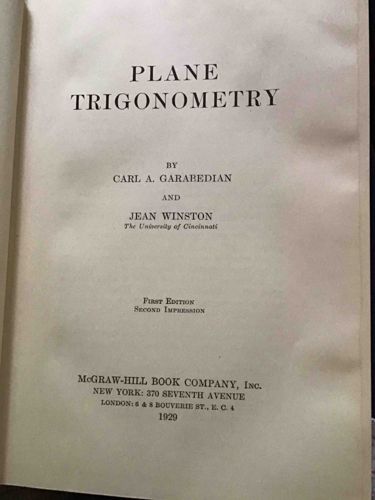
Plane Trigonometry by Garabedian and Winston (1929)

Book

AI Estimated Value

·Not an official valuation·Verify before acting

$25-50

As of May 27, 2026

AI Item Analysis

·AI can make mistakes·Verify before acting
This item is a copy of "Plane Trigonometry" by Carl A. Garabedian and Jean Winston from The University of Cincinnati. It is identified as a First Edition, Second Impression, published by McGraw-Hill Book Company, Inc. in 1929. The physical characteristics visible include aged, cream-colored paper with black printed text. The typeface appears to be a standard serif font, typical of texts from the early 20th century, indicating a classic academic style. Given its age, the paper exhibits a natural patina, showing subtle discoloration consistent with nearly a century of existence. There are no immediate signs of significant damage such as tears, major creases, or heavy foxing which suggest the 'good condition' noted. The binding is not visible but the page itself appears relatively flat, indicating it is likely well-preserved, though a slight ripple might be present on the right edge. The printing is clear and crisp, without any smudging or significant fading, indicating good quality printing for its time. The clear legibility of the text and lack of severe staining suggest it has been stored appropriately. This particular edition provides a timestamp from the interwar period, offering historical context to the academic curriculum of the time.

AI Appraisal Report

·AI can make mistakes·Verify before acting
I have examined the provided image of “Plane Trigonometry” by Garabedian and Winston, published by McGraw-Hill in 1929, identified as a First Edition, Second Impression. Based on the visual evidence, the paper displays age-appropriate cream coloring and a standard serif typeface typical of the era. The printing appears clear and crisp, with no immediate signs of smudging or significant fading, suggesting good print quality for its time. The absence of visible tears, major creases, or heavy foxing supports the owner's claim of “Good condition.” The relatively flat page indicates a potentially well-preserved binding, though this cannot be fully assessed without a direct view.The market for academic textbooks from this period is generally modest, unless authored by a particularly prominent figure or associated with a significant historical event. While Garabedian and Winston were academics at the University of Cincinnati, they are not widely recognized as foundational figures whose works command high prices in the collectible book market. Demand for this specific title would likely come from niche collectors of historical mathematics texts or university archives. It is not considered rare. Factors impacting its value negatively include its nature as a textbook and its second impression status within the first edition, which marginally reduces desirability compared to a true first printing. The primary limitation in full authentication is the inability to physically inspect the binding, all pages for completeness, internal foxing, previous ownership marks, or repairs. A physical examination would allow me to verify the binding integrity, confirm all pages are present and free from hidden defects, and thoroughly assess any hidden wear or repairs that could impact value. Provenance documentation, such as original receipts or previous owner details, would further enhance authentication and historical context.

Get your items appraised

Instant estimates of your treasures with AI-powered appraisals

Browse More Appraisals