These notes were written by the person who submitted this item. Appraiser.AI has not verified them, and the AI's identification and estimate may rely on them.
AI Estimated Value
Not an official valuation
$40-60
AI estimate as of October 9, 2025 · verify with a professional before acting
AI-Generated · Verify before acting
Everything on this page is generated by AI for informational purposes only. AI can make mistakes — the AI may misidentify items or misattribute them (artist, maker, brand, designer, origin, era). This is not an official valuation and should not be used for insurance, sale, tax, estate, legal, or lending purposes — or any decision requiring a certified appraisal. It is not an authoritative claim about any person, brand, or rights holder — do not share or rely on it as a factual statement about a third party. Always consult qualified professionals before making financial decisions.
This analysis also relies on unverified notes provided by the user, which may be incomplete or inaccurate and could affect the result.
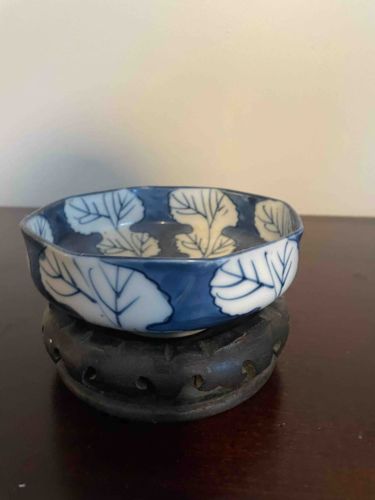
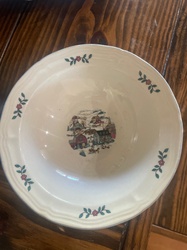
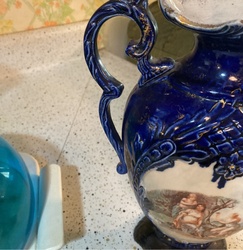
This is a small, square-shaped porcelain bowl, likely of Japanese origin, featuring a distinct blue and white underglaze decoration. The bowl measures approximately 4-5 inches across based on the visual context. Its shape is not perfectly round, but rather has gently curved sides that hint at a squared or quatrefoil form, contributing to its artisanal appeal. The primary decorative motif consists of large, stylized leaves rendered in white and a lighter, off-white hue against a vibrant, cobalt blue background. The leaves are outlined and detailed with fine blue lines, suggesting veins and contours, showcasing a traditional East Asian aesthetic often found in 'sometsuke' (blue and white) ware. The interior and exterior surfaces of the bowl are adorned with these leaf patterns, creating a cohesive visual design. The rim of the bowl appears to have a slightly irregular, hand-formed quality, adding to its uniqueness. The porcelain body has a smooth, glazed finish, and the blues vary slightly in intensity, indicating hand-painting rather than a uniform machine application. The condition appears to be good, with no immediately visible chips, cracks, or significant wear. There might be some minor surface irregularities consistent with handmade ceramics. The bowl sits atop a separate, dark-colored, possibly wooden or ceramic stand with openwork details, which is not part of the bowl itself but suggests it was displayed with care. The craftsmanship suggests a mid-20th century or earlier origin, typical of export ware or domestic production intended for everyday use or decorative purposes. The quality of the hand-painting, particularly the delicate outlining of the leaves, indicates a skilled artisan.
AI Appraisal Report
Upon examining the provided images and description, I have evaluated this Japanese blue and white porcelain bowl. The piece presents as a 'sometsuke' (blue and white) ware, likely dating to the mid-20th century, possibly the Showa period (1926-1989). Its square, or quatrefoil, form and hand-painted leaf motif are characteristic of Japanese ceramics produced for both domestic use and export during this era. The apparent good condition, with no visible chips or cracks, is a positive attribute. The hand-painted nature, indicated by slight variations in the cobalt blue, adds to its artisanal charm but does not suggest exceptional rarity.
The current market for mid-20th century Japanese 'sometsuke' of this quality is relatively modest. While aesthetically pleasing, such bowls are quite common. Comparables can be found at auction and online marketplaces, where similar individual bowls typically sell for under $100. The primary value drivers are its decorative appeal and good condition rather than rarity or historical importance. The included display stand, while complementary, is likely a later addition and does not significantly impact the bowl's intrinsic value.
A significant limitation of this appraisal is that it is based solely on images. A full authentication would require in-person examination to assess the porcelain body's quality, feel the glaze texture, and, most importantly, inspect for a maker's mark or kiln mark on the underside. Without a mark from a renowned artist or kiln and without provenance documentation, the item is valued as a decorative piece of good craftsmanship from its period.