These notes were written by the person who submitted this item. Appraiser.AI has not verified them, and the AI's identification and estimate may rely on them.
AI Estimated Value
Not an official valuation
$15-25
AI estimate as of July 13, 2025 · verify with a professional before acting
AI-Generated · Verify before acting
Everything on this page is generated by AI for informational purposes only. AI can make mistakes — the AI may misidentify items or misattribute them (artist, maker, brand, designer, origin, era). This is not an official valuation and should not be used for insurance, sale, tax, estate, legal, or lending purposes — or any decision requiring a certified appraisal. It is not an authoritative claim about any person, brand, or rights holder — do not share or rely on it as a factual statement about a third party. Always consult qualified professionals before making financial decisions.
This analysis also relies on unverified notes provided by the user, which may be incomplete or inaccurate and could affect the result.
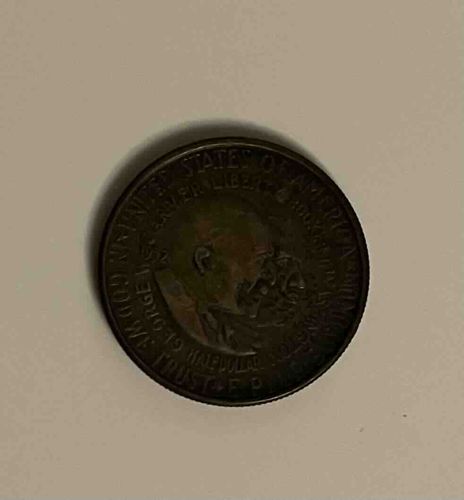
The item is a 1952 Booker T. Washington and George Washington Carver commemorative half dollar coin, also known as a Carver-Washington Half Dollar. It appears to be made of a silver alloy, typical for U.S. half dollars of this period (90% silver, 10% copper), but exhibits significant toning, giving it a dark, almost bronze or copper-like coloration with reddish-brown hues, likely due to oxidation and environmental exposure over time. The obverse of the coin features a dual portrait of Booker T. Washington on the left and George Washington Carver on the right. Both figures are depicted in profile, facing leftward. The inscription 'UNITED STATES OF AMERICA' is visible along the top rim, 'BOOKER T. WASHINGTON' and 'GEORGE W. CARVER' are positioned below their respective busts, and 'HALF DOLLAR' is partially visible. The motto 'IN GOD WE TRUST' is also present, along with what appears to be the mintmark 'F D' or designer's initials 'FD' below the portraits. The date '1952' is clearly discernible. The coin exhibits signs of moderate wear consistent with circulation, particularly on the higher points of the portraits and lettering, indicating a circulated condition rather than uncirculated. There are no obvious severe damages like deep scratches or significant dings, but the overall patina obscures some finer details and lustre. The toning is uneven, suggesting it was not stored optimally. The craftsmanship is consistent with U.S. Mint coinage of the mid-20th century, displaying good detail despite the toning and wear. The reeding on the edge is not visible in the provided image.
AI Appraisal Report
I have examined the provided image and description of your 1952 Booker T. Washington and George Washington Carver Half Dollar. Based on the visual evidence, the coin appears to be an authentic U.S. commemorative half dollar from 1952. The dual portraits, inscriptions, and date align with known examples of this issue.
The condition assessment is challenging from an image alone, especially regarding surface nuances. However, the visible wear on the high points of the portraits and lettering suggests a circulated condition, likely in the Fine to Very Fine (F-VF) range. The significant, dark, and uneven toning is noteworthy. While some collectors appreciate natural toning, this level, described as almost bronze or copper-like with reddish-brown hues, might deter some, potentially impacting its aesthetic appeal and thus its market value for high-grade collectors. No severe damages like deep scratches or dings are apparent, which is positive.
Regarding demand and rarity, the 1952 Booker T. Washington and George Washington Carver Half Dollar is not considered rare; its mintage was approximately 2,006,292 across three mints (Philadelphia, Denver, and San Francisco). While historically significant, it's a readily available issue for collectors. Market conditions for circulated commemorative half dollars like this are generally stable, driven more by historical interest and silver content than speculative demand.
The primary factors impacting value here are the circulated grade and the intense toning. In-person examination would be required to accurately grade the coin, assess the true nature and stability of the toning, and verify the absence of hidden scratches or environmental damage. For full authentication, especially for significantly higher values, a professional grading service (PCGS, NGC) would be recommended, as they perform detailed examinations that include verifying metal composition and strike quality.
Considering the apparent circulated condition and the visible toning, which, while natural, may not be universally desirable, the value is primarily driven by its silver content plus a modest numismatic premium. I cannot definitively determine the specific mintmark from the image, which can have a slight impact on value, though less so for circulated examples.