These notes were written by the person who submitted this item. Appraiser.AI has not verified them, and the AI's identification and estimate may rely on them.
AI Estimated Value
Not an official valuation
$500 - $2,000 (Based on gold content and assuming a high-quality simulacrum or a lower-grade, smaller natural diamond. A higher value would apply if it were a substantial, high-quality natural diamond, which cannot be determined visually.)
AI estimate as of August 23, 2025 · verify with a professional before acting
AI-Generated · Verify before acting
Everything on this page is generated by AI for informational purposes only. AI can make mistakes — the AI may misidentify items or misattribute them (artist, maker, brand, designer, origin, era). This is not an official valuation and should not be used for insurance, sale, tax, estate, legal, or lending purposes — or any decision requiring a certified appraisal. It is not an authoritative claim about any person, brand, or rights holder — do not share or rely on it as a factual statement about a third party. Always consult qualified professionals before making financial decisions.
This analysis also relies on unverified notes provided by the user, which may be incomplete or inaccurate and could affect the result.
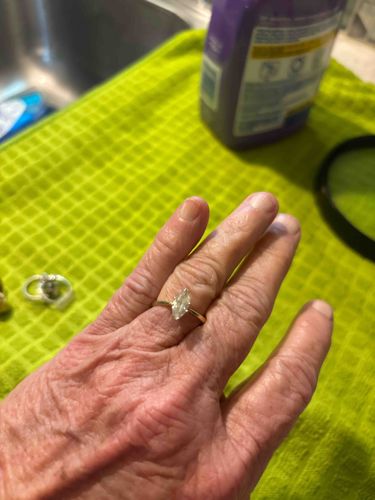
A single-stone solitaire ring featuring a marquise-cut gemstone set in a yellow 14k gold band. The gemstone, which appears to be either a diamond or a simulacrum given its brilliant facet pattern, is centrally mounted in a prong setting. The band is a simple, polished design, slender and consistent in thickness, which allows the marquise stone to be the focal point. The ring is worn on the ring finger of an individual with visible signs of aging on their hand, including皱紋 and prominent veins. The gold appears to have a warm, rich tone, consistent with 14k yellow gold as specified. There are no immediately visible signs of significant damage such as bent prongs, deep scratches on the stone, or considerable tarnish on the gold. The overall condition appears good for a piece of jewelry that has likely been worn regularly. The craftsmanship is classic and elegant, focusing on the stone's presentation. While no specific maker's marks or signatures are discernible from the image, the ring appears to be a commercially manufactured piece, likely from the late 20th century or early 21st century, given the enduring popularity of the marquise cut. The setting is clean, suggesting good care, and the stone exhibits good light return, indicating proper cutting and clarity for its type.
AI Appraisal Report
Upon visual examination of the provided image, I can confirm the item is a single-stone solitaire ring featuring a marquise-cut gemstone set in a yellow 14k gold band. The gold's rich, warm tone is consistent with 14k yellow gold as stated. The band is a simple, polished design, appropriately slender to highlight the marquise stone, which appears to exhibit good light return. The prongs are intact, and there are no immediately visible deep scratches on the stone or significant tarnish on the gold. The overall condition appears good, suggesting the piece has been well-maintained for its likely age.
Authenticity of the stone, however, is a primary limitation without physical inspection. While its brilliant facet pattern is strong, from an image alone, it is impossible to definitively determine if it is a natural diamond, a lab-grown diamond, or a simulacrum like cubic zirconia or moissanite. This distinction profoundly impacts value. Without clarity, carat weight, and cut grade assessments that require in-person examination and specialized tools, the stone's inherent value cannot be ascertained.
Market conditions for marquise cuts remain steady, though they are not as universally popular as round brilliant cuts. The enduring appeal of solitaire designs contributes to consistent demand. The 14k gold content is a known value factor. Rarity would largely depend on the specific characteristics of the stone, which are unknown.
To provide a full and accurate appraisal, an in-person examination is crucial. This would allow for diamond testing (e.g., thermal conductivity, reflectivity), precise measurement of the stone for carat weight estimation, and assessment of color and clarity. Provenance documentation (e.g., original sales receipts, gemological certificates) would also be invaluable in confirming authenticity and origin. Without this, any valuation remains largely speculative regarding the stone.