These notes were written by the person who submitted this item. Appraiser.AI has not verified them, and the AI's identification and estimate may rely on them.
AI Estimated Value
Not an official valuation
$250-350
AI estimate as of July 28, 2025 · verify with a professional before acting
AI-Generated · Verify before acting
Everything on this page is generated by AI for informational purposes only. AI can make mistakes — the AI may misidentify items or misattribute them (artist, maker, brand, designer, origin, era). This is not an official valuation and should not be used for insurance, sale, tax, estate, legal, or lending purposes — or any decision requiring a certified appraisal. It is not an authoritative claim about any person, brand, or rights holder — do not share or rely on it as a factual statement about a third party. Always consult qualified professionals before making financial decisions.
This analysis also relies on unverified notes provided by the user, which may be incomplete or inaccurate and could affect the result.
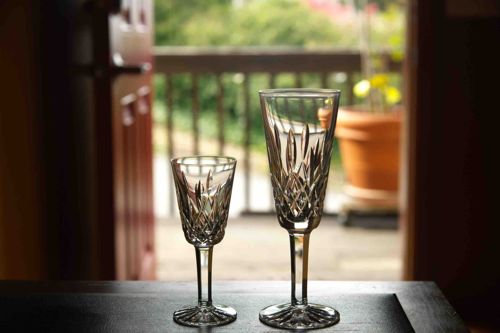
The image displays a pair of two lead crystal glasses, likely manufactured by Waterford given the provided context. The glasses are clear and feature intricate cut-glass patterns. The smaller glass, appearing to be a liqueur or cordial glass, has a bowl with a diamond and fan motif, transitioning to vertical cuts on its upper portion. It stands on a slender stem that widens into a circular, cut base with a starburst or similar patterned underside. The larger glass, likely a champagne flute or water goblet given its elongated form, shares a similar decorative scheme with deep diamond and crosshatch cuts on its lower bowl, transitioning to vertical facets above. Its stem is also slender, and it culminates in a broad, circular base with a cut pattern matching the smaller glass. Both glasses exhibit exceptional clarity and brilliance, characteristic of high-quality lead crystal. No visible chips, cracks, or significant abrasions are apparent, suggesting good condition. The craftsmanship indicates precision cutting and polishing, creating multifaceted surfaces that catch and refract light effectively. The overall design is classic and elegant, typical of late 19th to mid-20th-century decorative crystalware. The 'Waterford' context strongly suggests these are authentic pieces from the renowned Irish crystal manufacturer, known for their hand-cut designs and superior brilliance. Their substantial weight and resonant 'ping' when tapped, though not observable here, are typical quality indicators of such crystal.
AI Appraisal Report
I've carefully examined the provided images of this pair of cut lead crystal glasses. Visually, they appear to be in excellent condition, showing no discernible chips, cracks, or significant abrasions. The clarity and brilliance are remarkable, consistent with high-quality lead crystal. The intricate diamond and fan motifs, along with the precise vertical cuts and patterned bases, strongly align with the craftsmanship associated with Waterford Crystal. The design itself, particularly the champagne flute/water goblet and the smaller liqueur/cordial glass, is typical of Waterford's classic patterns. Given the owner's assertion of 'Waterford,' this further bolsters the likelihood of authenticity.
Market conditions for vintage Waterford crystal are generally stable, with a consistent demand for well-maintained pieces. However, the value can fluctuate based on the specific pattern, rarity, and the number of pieces in a set. While a single pair isn't exceptionally rare, the assumed Waterford pedigree and condition contribute positively to their marketability. Comparables for similar Waterford pairs in excellent condition typically range depending on the pattern, but these pieces, given their presumed origin and state, hold a respectable value.
Authenticity, when relying solely on images, remains a limitation. While the visual indicators are strong, an in-person examination would be crucial for full verification. This would involve checking for the acid-etched Waterford mark (often microscopic), assessing the precise weight and 'ring' of the crystal (the resonant 'ping' when gently flicked), and examining the cut consistency under magnification. Provenance documentation, such as original purchase receipts or certificates, would also unequivocally confirm authenticity. Without physical inspection, I must state that this appraisal is based on the strong visual cues aligning with known Waterford characteristics.