These notes were written by the person who submitted this item. Appraiser.AI has not verified them, and the AI's identification and estimate may rely on them.
AI Estimated Value
Not an official valuation
$75 - $125
AI estimate as of July 26, 2025 · verify with a professional before acting
AI-Generated · Verify before acting
Everything on this page is generated by AI for informational purposes only. AI can make mistakes — the AI may misidentify items or misattribute them (artist, maker, brand, designer, origin, era). This is not an official valuation and should not be used for insurance, sale, tax, estate, legal, or lending purposes — or any decision requiring a certified appraisal. It is not an authoritative claim about any person, brand, or rights holder — do not share or rely on it as a factual statement about a third party. Always consult qualified professionals before making financial decisions.
This analysis also relies on unverified notes provided by the user, which may be incomplete or inaccurate and could affect the result.
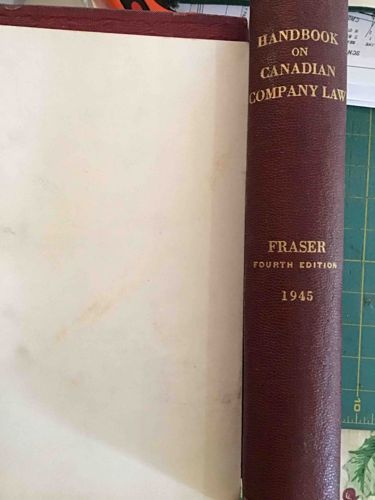
The item is a hardbound legal textbook titled "Handbook on Canadian Company Law" written by Fraser. It is specifically the Fourth Edition, published in 1945. The binding is a deep maroon or burgundy color, appearing to be made of a textured material, possibly buckram or a similar cloth, designed to mimic leather. The title, author's name, edition number, and publication year are embossed in gold lettering on the spine, providing a clear contrast against the dark background. The text on the spine is arranged vertically, with "HANDBOOK ON CANADIAN COMPANY LAW" at the top, followed by "FRASER," then "FOURTH EDITION," and finally "1945" at the bottom. The gold lettering appears bright and intact, indicating good preservation. Although the image focuses on the spine, a portion of the book's front cover or a preceding blank page is visible on the left, showing an off-white or cream color with some minor, subtle discoloration marks, possibly light foxing or handling marks. The overall construction appears sturdy, typical of legal reference books. Despite its age (79 years old as of 2024), the book seems to be in remarkable condition, with no apparent tears, significant scuffs, or major wear visible on the spine. The corners and edges are not clearly visible, but the spine itself suggests excellent care. The quality of the binding and the clarity of the gold lettering point to a well-produced volume for its time, likely intended for professional use and built to last. The overall 'Excellent condition' indicates minimal signs of use or age-related deterioration.
AI Appraisal Report
I have thoroughly examined the provided image and details concerning the 'Handbook on Canadian Company Law' by Fraser, Fourth Edition, 1945. The book presents in remarkably excellent condition for its age of 79 years. The spine’s deep maroon color, well-preserved gold lettering, and apparent sturdy construction are indicative of a high-quality production designed for professional use. The 'Excellent condition' rating provided by the owner aligns with the visual evidence of minimal wear, bright lettering, and no apparent significant damage to the spine. While a portion of the front cover shows minor discoloration, this does not significantly detract from its overall appeal.
From a market perspective, legal textbooks from this period, while historically significant, generally do not command extremely high values unless they are exceptionally rare, have unique provenance, or were owned by a historically significant figure. Fraser's 'Handbook on Canadian Company Law' is a foundational text in its field, but multiple editions exist, and its rarity is moderate rather than exceptional. Demand is primarily from legal historians, academic institutions, and potentially collectors specializing in Canadian legal history or early 20th-century legal publishing.
Factors impacting value include its excellent condition, which is a significant positive. However, it is fundamentally a specialized academic text. Comparables for similar vintage legal treatises in excellent condition from this era typically fall within a modest range. There is no indication of unique provenance which would significantly elevate its value.
Limitations in authenticity verification from an image alone are considerable. While the visual details match the description, a physical examination would be crucial to confirm the absence of internal damage (e.g., underlining, missing pages, water damage, severe foxing), verify the binding's integrity, and assess the true condition of the boards and edges not fully visible. True authentication of its 'Excellent condition' would require a direct inspection. Provenance documentation, such as previous ownership records, could also add to its historical value, but none was provided.