AI estimate as of August 2, 2025 · verify with a professional before acting
AI-Generated · Verify before acting
Everything on this page is generated by AI for informational purposes only. AI can make mistakes — the AI may misidentify items or misattribute them (artist, maker, brand, designer, origin, era). This is not an official valuation and should not be used for insurance, sale, tax, estate, legal, or lending purposes — or any decision requiring a certified appraisal. It is not an authoritative claim about any person, brand, or rights holder — do not share or rely on it as a factual statement about a third party. Always consult qualified professionals before making financial decisions.
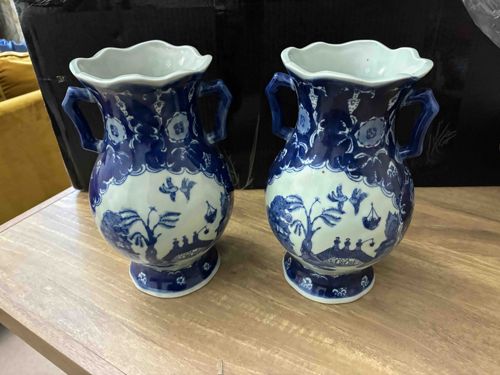
This is a pair of ceramic vases, likely porcelain or earthenware, featuring a distinct blue and white 'Delft' or 'Export' style decoration. Each vase presents a bulbous body tapering towards a flared, scalloped rim. Both vases are equipped with two handles that appear to be integrated into the shoulder of the pot and extend upwards towards the rim, creating an elegant silhouette. The primary color palette is a rich cobalt blue on a white background. The upper portion of the body and the neck are adorned with an intricate floral and scroll pattern in blue, separated from the lower body by a scalloped border. The lower, wider section of the body on each vase depicts a pastoral or landscape scene. Specifically, one vase features what appears to be a landscape with trees, flying birds or butterflies, and a hanging lantern-like object, while the other shows a similar landscape with what looks like figures on a bridge or path over water. The base is pedestal-like, flaring slightly outward, and also decorated with blue motifs, possibly stylized floral or geometric patterns. The interior of the rim is a plain off-white or light blue. Visible condition appears good, with no obvious chips, cracks, or repairs from the provided image. The glaze appears to be intact and shows a slight sheen, indicating well-preserved finish. The craftsmanship suggests they are mass-produced but with a good level of detail in the hand-painted or transfer-printed decoration. The style hints at an East Asian influence, possibly Chinese export ware, or European imitation such as Delftware, likely dating from the late 19th to mid-20th century.
AI Appraisal Report
Upon visual examination of the provided image, this pair of blue and white ceramic vases exhibits good overall condition. I observe no obvious chips, cracks, or repairs, and the glaze appears well-preserved with a slight sheen. The detailed blue on white decoration, featuring intricate floral patterns, scalloped borders, and distinct landscape scenes, suggests a relatively high level of craftsmanship, consistent with either Chinese export ware or European Delftware imitations. The form, with its bulbous body, flared scalloped rim, and integrated handles, is aesthetically pleasing and functional.
From the image alone, definitive authentication of origin and age is challenging. While the style strongly hints at an East Asian influence, similar decorative motifs and forms were adopted by European manufacturers. Without physical examination, I cannot confirm whether the decoration is hand-painted or transfer-printed, which significantly impacts value. Hand-painted examples are generally more valuable. Similarly, the specific ceramic body (porcelain vs. earthenware) cannot be ascertained through imagery alone, impacting durability and historical context.
In terms of market conditions, blue and white ceramics consistently maintain a moderate demand, particularly pieces with decorative scenes. Comparables for similar decorative vases, assuming late 19th to mid-20th century production and good condition, typically fall within a modest range. Rarity for mass-produced items from this period is not high, but a complete matching pair in good condition adds to their desirability. Key factors impacting value include the actual origin (e.g., authentic antique Chinese export would be significantly more valuable than modern reproductions), method of decoration, and material quality.
For a full and definitive authentication, an in-person examination would be crucial to assess the potting, glaze quality, foot rim construction, and decoration technique. Provenance documentation, if available, would provide historical context and ownership lineage. Scientific testing, such as thermoluminescence dating, could confirm age, especially if an antique origin is suspected. Without these, my assessment is based solely on visual characteristics, which limit definitive conclusions on authenticity and precise age.