AI Appraisal Estimate

AI-generated estimates · not official valuations

From the user

What was submitted

Photo and notes provided by the user — not generated by AI

Submitted item photo
Submitted photo · May 27, 2026

User's notes

No additional notes provided.

AI analysis below

AI appraisal

AI analysis & estimate

AI-Generated · Verify before acting

Everything below is generated by AI for informational purposes only. AI can make mistakes — the AI may misidentify items or misattribute them (artist, maker, brand, designer, origin, era). This is not an official valuation and should not be used for insurance, sale, tax, estate, legal, or lending purposes — or any decision requiring a certified appraisal. It is not an authoritative claim about any person, brand, or rights holder — do not share or rely on it as a factual statement about a third party. Always consult qualified professionals before making financial decisions.

Read the full disclaimer

AI Identification

·Not independently authenticated·Verify before acting

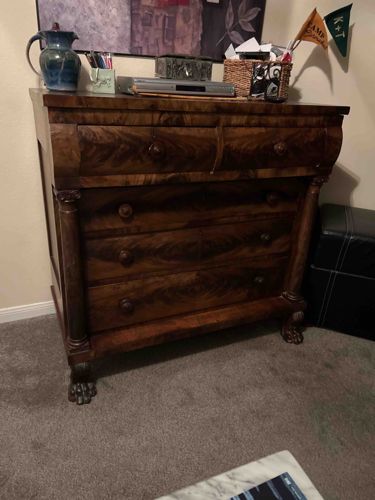
American Empire Mahogany Veneer Chest of Drawers

Antique Furniture

AI Estimated Value

·Not an official valuation·Verify before acting

$1,200 - $1,800

As of May 27, 2026

AI Item Analysis

·AI can make mistakes·Verify before acting
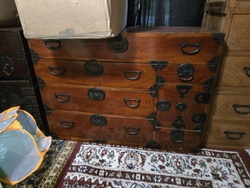
This is a fine example of an American Empire style chest of drawers, likely dating from the mid-19th century (circa 1830–1850). The piece is constructed with a dark mahogany wood base, featuring highly dramatic flame mahogany veneers across the drawer fronts arranged in a book-matched pattern. This configuration includes a large, deep ogee-mold top drawer over three recessed lower drawers. The piece is flanked by a pair of prominent cylindrical columns topped with carved acanthus-style capitals. It rests on large, ornately carved hairy-paw feet, a hallmark of the late Empire and Classical Revival periods. Each drawer is fitted with circular wooden mushroom knobs that appear contemporary to the piece's style. The construction shows a solid, heavy frame typical of the period's preference for monumental forms. Condition-wise, the chest exhibits a rich, aged patina with some visible surface wear. There are noticeable areas of veneer loss and cracking, particularly on the base rail near the left foot and along the edges of the ogee drawer. The finish shows some dulling and superficial scratches consistent with age and domestic use. The quality of the book-matched veneer and the intricate carving of the feet indicate a high level of mid-Victorian craftsmanship, likely produced by a skilled regional cabinetmaker in the Eastern United States.
AI Appraisal Report

·AI can make mistakes·Verify before acting
I have examined the provided images of this American Empire chest of drawers, circa 1840. The piece exemplifies the 'Grecian Plain' style, characterized by its monumental ogee-mold top drawer and book-matched flame mahogany veneers. The acanthus-carved capitals and the presence of ornate hairy-paw feet represent high-style features that distinguish this from more utilitarian country pieces. Based on visual inspection, the patina appears consistent with 19th-century mahogany, and the wooden mushroom knobs appear period-appropriate. The condition shows significant veneer loss on the base rail and cracking on the ogee drawer, which negatively impacts the value. In today’s market, interest in 'brown furniture' remains selective; however, pieces with exceptional carving, like these paw feet, maintain a premium over simpler turned-leg versions. Comparable sales in regional auction houses for similar mahogany chests in 'good but worn' condition typically range between $1,000 and $2,000. Limitations: My assessment is based solely on digital images. Without a physical inspection, I cannot verify the secondary woods (such as white pine or poplar), which would confirm an Eastern U.S. origin. I cannot inspect the joinery (dovetails) or the undersides for 'ghost' marks of missing locks or replaced hardware. A full authentication would require checking for saw marks on the back panels and drawer bottoms to rule out late 19th-century revivals. Provenance documentation or a family history of ownership would also be necessary to solidify its historical value.

Get your items appraised

Instant estimates of your treasures with AI-powered appraisals

Browse More Appraisals