AI Appraisal Estimate

AI-generated estimates · not official valuations

From the user

What was submitted

Photo and notes provided by the user — not generated by AI

Submitted item photo
Submitted photo · May 23, 2026

User's notes

No additional notes provided.

AI analysis below

AI appraisal

AI analysis & estimate

AI-Generated · Verify before acting

Everything below is generated by AI for informational purposes only. AI can make mistakes — the AI may misidentify items or misattribute them (artist, maker, brand, designer, origin, era). This is not an official valuation and should not be used for insurance, sale, tax, estate, legal, or lending purposes — or any decision requiring a certified appraisal. It is not an authoritative claim about any person, brand, or rights holder — do not share or rely on it as a factual statement about a third party. Always consult qualified professionals before making financial decisions.

Read the full disclaimer

AI Identification

·Not independently authenticated·Verify before acting

Ancient or Vintage Cross Pendant

Religious Artifact

AI Estimated Value

·Not an official valuation·Verify before acting

$100-200

As of May 23, 2026

AI Item Analysis

·AI can make mistakes·Verify before acting
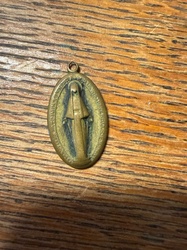
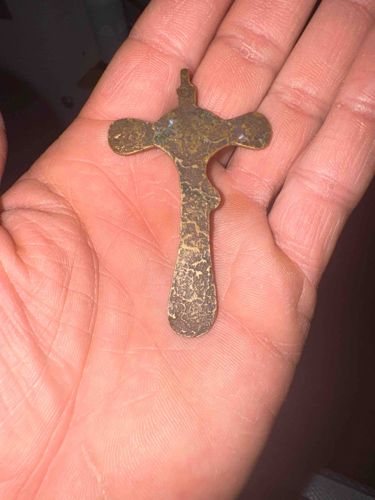
This item is a small, possibly ancient or vintage, cross-shaped pendant, likely made of bronze or an aged brass alloy, given its distinct dark brown to brassy-bronze coloration. The surface of the metal exhibits significant patination, characterized by a heavily textured, almost bark-like or mottled appearance, which suggests considerable age and exposure to elements. The shape is that of a Latin cross, though it features a small, elongated finial at the very top, possibly for suspension as a pendant or attachment. The horizontal arms of the cross are relatively short and curve slightly upwards at their ends, ending in rounded points. The vertical shaft is longer and widens slightly towards the bottom, culminating in a rounded, somewhat spatulate end. There are no discernible markings, engravings, or intricate designs on its surface, indicating a minimalist or possibly very early stylistic approach. The construction appears to be solid, cast metal. The condition shows no obvious signs of damage such as breaks or repairs, but the heavily oxidized and textured surface is a primary characteristic of its age. The item's roughly finished edges and irregular surface texture point to hand-casting or a similar ancient manufacturing process. The item's small size suggests it was intended as a personal devotional object, likely worn as jewelry or carried as a talisman. Its unadorned nature contributes to a sense of historical gravitas, hinting at a period where functional and symbolic representation was prioritized over elaborate ornamentation.

AI Appraisal Report

·AI can make mistakes·Verify before acting
I have examined the image of this ancient or vintage cross pendant. Based on its distinct dark brown to brassy-bronze coloration and heavily-textured patina, I assess it as likely being bronze or an aged brass alloy. The "bark-like" surface texture and rough finish are consistent with ancient or early manufacturing processes, possibly indicative of hand-casting. The condition appears stable, with the patination being a natural characteristic rather than damage. Authenticity, based on visual evidence, suggests it is indeed an old piece, however, definitive age and origin cannot be fully determined from images alone. Market comparables for unadorned, small bronze crosses of indeterminate origin typically fall within a modest range. While the age and "gravitas" are appealing, the lack of intricate designs, specific iconography, or clear historical markers limits its upper value. Demand exists among collectors of ancient artifacts or devotional items, but this specific piece lacks the rarity of documented or highly artistic examples. Factors impacting value negatively include the inability to pinpoint its exact age, culture, or definitive purpose without further research. Limitations in authenticity verification are significant. A physical examination would be crucial to assess the metal composition more accurately, a microscopic analysis of the patina to differentiate natural aging from artificial treatments, and a detailed examination of manufacturing marks. Provenance documentation, connecting it to a known historical context or archaeological find, would immensely elevate its value. Without these, it remains a charming but largely speculative piece regarding its precise historical significance.

Get your items appraised

Instant estimates of your treasures with AI-powered appraisals

Browse More Appraisals