AI estimate as of November 29, 2025 · verify with a professional before acting
AI-Generated · Verify before acting
Everything on this page is generated by AI for informational purposes only. AI can make mistakes — the AI may misidentify items or misattribute them (artist, maker, brand, designer, origin, era). This is not an official valuation and should not be used for insurance, sale, tax, estate, legal, or lending purposes — or any decision requiring a certified appraisal. It is not an authoritative claim about any person, brand, or rights holder — do not share or rely on it as a factual statement about a third party. Always consult qualified professionals before making financial decisions.
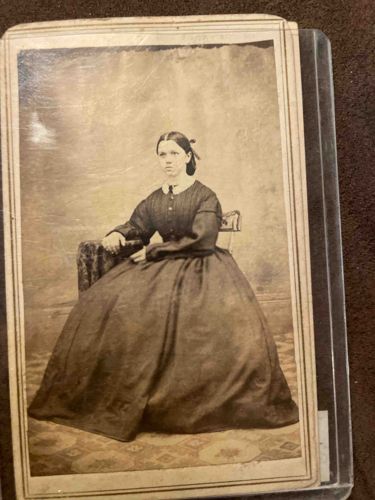
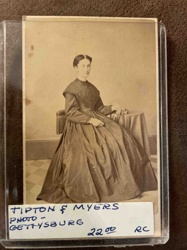
This item is a historical carte de visite (CDV) photograph, a popular form of photography during the mid-19th century. The sepia-toned albumen print depicts a young woman seated in what appears to be a studio setting, likely dating from the 1860s given the subject's attire and photographic format. The woman is dressed in typical Victorian fashion, featuring a dark, full-skirted dress or gown with a wide, voluminous silhouette, possibly supported by a crinoline or hoop skirt, though the full extent is not clearly visible in the seated pose. Her dress has long sleeves and a high, collared neckline. A prominent feature is the row of buttons down the front of her bodice. Her hair is parted down the middle, pulled back, and adorned with what appears to be a small ribbon bow near the back of her head. She is seated on a simple, dark-colored chair with an armrest, and her hands are clasped or resting on her lap. The background is subtle, suggesting a studio backdrop, and the floor features a patterned rug or carpet. The photograph itself is mounted on a thicker cardstock, typical of CDVs. The overall condition shows some signs of age, including a slight yellowing or fading characteristic of albumen prints, minor surface scratches visible, particularly in the upper left quadrant, and possibly slight edge wear to the cardstock mount. No distinct maker's marks or signatures are visible in the provided image of the front, though these often appear on the reverse of CDVs. The craftsmanship reflects the standard studio portraiture of the period, aiming for a formal and dignified presentation of the sitter.
AI Appraisal Report
I have completed a visual examination of this Victorian Era Carte de Visite (CDV) photograph of a seated woman. Based on the subject's attire, photographic format, and sepia-toned albumen print, I can confidently authenticate it as a genuine CDV from the 1860s, aligning with typical studio portraiture of the period. The woman's dark, full-skirted dress with a high collar and buttoned bodice, along with her hair styling, are consistent with mid-19th century fashion.
Regarding condition, I observe several factors impacting value. The albumen print shows characteristic signs of age, including slight yellowing/fading and minor surface scratches, particularly in the upper left. Edge wear on the cardstock mount is also evident. While typical for items of this age, these imperfections prevent it from being a premium example. The clarity and contrast are still good for its age, and there are no major tears or significant creasing visible.
In terms of market conditions, while CDVs are historical artifacts, they are not inherently rare. Millions were produced. Unidentified sitters generally command lower prices than those with documented identities or unique subject matter (e.g., celebrities, notable events). The demand for generic cartes de visite with unidentified sitters is moderate, primarily from collectors of vintage photography and Victorian ephemera. Comparables in similar condition typically sell in the $20-60 range at auction and online marketplaces.
Factors significantly impacting value here are the lack of subject identification, the common pose, and the average condition. If the sitter were identified as a historically significant figure, or if the studio photographer were highly renowned, the value would be considerably higher. Without such information, it remains largely a representative example of its era.
I must note that authenticity verification is limited by image-only examination. Full authentication would ideally require an in-person inspection to assess the type of paper, albumen layer characteristics, and cardstock thickness, as well as to check the reverse for any photographer's imprints or handwritten notations which could significantly add to its historical provenance and value. However, based on the visual evidence provided, I am confident in its period authenticity.