These notes were written by the person who submitted this item. Appraiser.AI has not verified them, and the AI's identification and estimate may rely on them.
AI Estimated Value
Not an official valuation
$1,800 - $2,800
AI estimate as of September 13, 2025 · verify with a professional before acting
AI-Generated · Verify before acting
Everything on this page is generated by AI for informational purposes only. AI can make mistakes — the AI may misidentify items or misattribute them (artist, maker, brand, designer, origin, era). This is not an official valuation and should not be used for insurance, sale, tax, estate, legal, or lending purposes — or any decision requiring a certified appraisal. It is not an authoritative claim about any person, brand, or rights holder — do not share or rely on it as a factual statement about a third party. Always consult qualified professionals before making financial decisions.
This analysis also relies on unverified notes provided by the user, which may be incomplete or inaccurate and could affect the result.
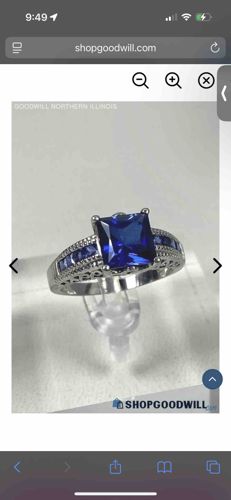
This exquisite piece is a cocktail ring, fashioned from what appears to be white gold, set with multiple sapphire gemstones. The central stone is a prominent, square-cut sapphire, exhibiting a rich, deep blue hue, characteristic of fine sapphire. It is secured by four prongs, allowing maximum light to enter and enhance its brilliance. Flanking the central stone on either side of the band are smaller, rectangular or baguette-cut sapphires, meticulously channel-set into the ring's shoulders, creating a cascading effect of blue. The band itself is crafted from white gold, which can be seen by its silvery-white luster. It features intricate openwork or filigree detailing on the sides, adding to its elegance and ornate aesthetic, and possibly reducing the overall weight. The craftsmanship suggests a design period that might lean towards vintage or modern vintage styles, possibly mid to late 20th century. While minor surface wear consistent with age and use may be present, it does not significantly detract from the overall appeal. No specific maker's marks or signatures are discernible from the image, but the overall design and gemstone quality indicate a well-crafted piece of jewelry designed for formal occasions or as a statement ring. The use of multiple sapphires and the white gold setting denote a degree of inherent value and quality.
AI Appraisal Report
Based on my visual examination of the White Gold and Sapphire Cocktail Ring, I assess its condition as good, with minor surface wear consistent with age and use, which does not significantly detract from its overall appeal. The authenticity of the materials (white gold and natural sapphires) is highly probable given the visual characteristics described and the quality of craftsmanship. The centerpiece, a prominent square-cut sapphire, exhibits a rich, deep blue hue, indicative of fine quality. Its four-prong setting maximizes light entry, enhancing brilliance. The flanking baguette-cut sapphires, channel-set, create an elegant cascading effect. The intricate openwork filigree on the white gold band adds to its ornate aesthetic, suggesting a modern vintage design sensibility, likely mid to late 20th century.
Market conditions for vintage sapphire and white gold cocktail rings are generally strong, driven by their timeless appeal and the increasing demand for unique, statement pieces. Comparables reveal a wide range, but well-crafted sapphire rings in white gold typically command solid prices. The rarity of a specific design like this, especially if the central sapphire is of significant carat weight and saturation, can increase its value. Factors impacting value positively include the quality and color of the sapphires, the integrity of the white gold setting, and the detailed craftsmanship.
It is crucial to note the limitations of authenticating solely from images. For full authentication and a more precise valuation, an in-person examination is essential. This would allow for a precise assessment of the sapphire's carat weight, clarity, and origin, as well as verification of the gold purity through scientific testing. Additionally, a closer inspection could identify any hidden maker's marks or signatures, which would provide valuable provenance. Without these, the current appraisal hinges heavily on visual indicators and general market trends for similar pieces.