AI Appraisal Estimate

AI-generated estimates · not official valuations

From the user

What was submitted

Photo and notes provided by the user — not generated by AI

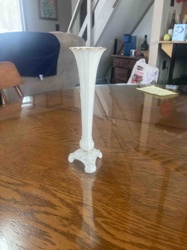
Submitted item photo
Submitted photo · June 6, 2026

User's notes

No additional notes provided.

AI analysis below

AI appraisal

AI analysis & estimate

AI-Generated · Verify before acting

Everything below is generated by AI for informational purposes only. AI can make mistakes — the AI may misidentify items or misattribute them (artist, maker, brand, designer, origin, era). This is not an official valuation and should not be used for insurance, sale, tax, estate, legal, or lending purposes — or any decision requiring a certified appraisal. It is not an authoritative claim about any person, brand, or rights holder — do not share or rely on it as a factual statement about a third party. Always consult qualified professionals before making financial decisions.

Read the full disclaimer

AI Identification

·Not independently authenticated·Verify before acting

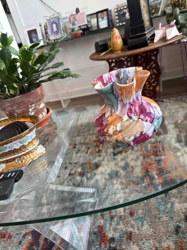
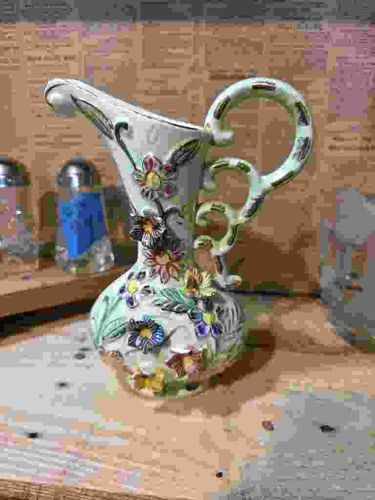
Vintage Majolica-Style Ceramic Pitcher with Applied Floral Relief

Decorative Arts / Ceramics

AI Estimated Value

·Not an official valuation·Verify before acting

$45 - $75

As of June 6, 2026

AI Item Analysis

·AI can make mistakes·Verify before acting
This item is a decorative ceramic pitcher or ewer, likely crafted in a mid-20th-century Majolica style. It features a cream-colored glazed body characterized by a slender neck, a widely flared spout, and a bulbous base. The most prominent feature is the heavy, three-dimensional applied ceramic floral relief that wraps around the center and neck. These hand-painted flowers exhibit a vibrant palette of purple, yellow, orange, and green, with dark outlining that suggests a folk art or Capodimonte influence. The handle is highly ornate, featuring a double-scrolled or 'C' scroll design with pale green accents and dark highlights to emphasize the texture. In terms of physical condition, the piece appears to be made of earthenware or slip-cast porcelain. There are visible signs of age including surface crazing, a characteristic fine network of cracks in the glaze. There are also potential small chips on the delicate flower petals, which is common in high-relief ceramic work. The craftsmanship indicates a production piece meant for decorative display rather than utilitarian use. No maker's mark is visible in the image, but the style is consistent with mid-century Italian or Japanese imports intended for the decorative arts market. The overall patina suggests the item is approximately 50-70 years old.
AI Appraisal Report

·AI can make mistakes·Verify before acting
Based on my visual examination, this decorative ewer is a representative example of mid-20th-century decorative ceramics. The piece mimics the traditional Majolica style through its high-relief floral application and bold, hand-painted glaze. While the 'Capodimonte style' flowers add visual interest, the slip-cast construction and the specific execution of the C-scroll handle suggest it was a mass-produced import, likely from Italy or Japan during the 1950s or 1960s. The presence of generalized crazing throughout the cream glaze is a typical aging characteristic of earthenware from this period, though it may be exacerbated by fluctuations in humidity. I noted minor losses to the delicate floral tips, which significantly limits collector interest, as these pieces rely heavily on their ornate 'perfection' for value. The market for mid-century decorative 'fancies' is currently stable but modest; they are often purchased for eclectic home staging rather than as blue-chip investments. Comparables for unsigned Italian-style floral pitchers of this size typically hammer for under $100 at neighborhood auctions. Without a maker’s mark (such as Ginori or a specific studio stamp), it remains a 'decorative object' rather than a 'collector's piece.' Please note that my valuation is based on photographic evidence. A physical inspection is required to check for structural cracks hidden by the relief work and to verify the clay body's density via a 'ring test.' Scientific testing of the glaze for lead content or microscopic examination of the crazing patterns would be necessary to rule out modern reproductions of this vintage style. Provenance or an original importer's label would also assist in refining the geographic origin.

Get your items appraised

Instant estimates of your treasures with AI-powered appraisals

Browse More Appraisals