These notes were written by the person who submitted this item. Appraiser.AI has not verified them, and the AI's identification and estimate may rely on them.
AI Estimated Value
Not an official valuation
$20-40
AI estimate as of July 24, 2025 · verify with a professional before acting
AI-Generated · Verify before acting
Everything on this page is generated by AI for informational purposes only. AI can make mistakes — the AI may misidentify items or misattribute them (artist, maker, brand, designer, origin, era). This is not an official valuation and should not be used for insurance, sale, tax, estate, legal, or lending purposes — or any decision requiring a certified appraisal. It is not an authoritative claim about any person, brand, or rights holder — do not share or rely on it as a factual statement about a third party. Always consult qualified professionals before making financial decisions.
This analysis also relies on unverified notes provided by the user, which may be incomplete or inaccurate and could affect the result.
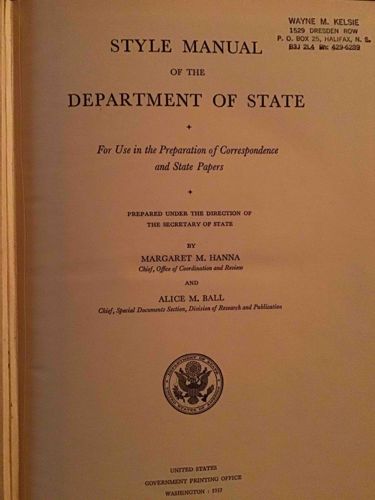
This item is the title page of a "Style Manual of the Department of State," published by the United States Government Printing Office in Washington. The page, likely a creamy off-white or light tan color, is printed with black ink. The title "STYLE MANUAL OF THE DEPARTMENT OF STATE" is prominently displayed in a large, serif typeface, with "DEPARTMENT OF STATE" being the largest and in bold. Below the main title, smaller text specifies its purpose: "For Use in the Preparation of Correspondence and State Papers." Further down, it indicates that the manual was "PREPARED UNDER THE DIRECTION OF THE SECRETARY OF STATE." The authors are listed as "MARGARET M. HANNA, Chief, Office of Coordination and Review" and "ALICE M. BALL, Chief, Special Documents Section, Division of Research and Publication." A circular seal of the United States, depicting an eagle with spread wings and a shield, is centrally located on the lower half of the page. The bottom of the page clearly states "UNITED STATES GOVERNMENT PRINTING OFFICE WASHINGTON," followed by a year, which appears to be "1957" based on common publication practices for this era. A handwritten or stamped annotation in the upper right corner indicates "WAYNE M. KELSIE 1529 DRESDEN ROW P. O. BOX 25, HALIFAX, N. S. B3J 2L4 902: 429-6239", suggesting a previous owner or library marking. The page shows minor signs of age and handling, consistent with its indicated good condition, with no visible tears, significant creases, or heavy foxing. The paper appears to be of standard book-quality for government publications of the mid-20th century. The typesetting is clear and professional, typical of federal printing.
AI Appraisal Report
Upon examining the provided image and information regarding this 1957 'Style Manual of the Department of State,' I find it to be in good condition, consistent with descriptions. The clarity of print, lack of significant tears or heavy foxing, and standard paper quality for the era are all positive indicators. The handwritten annotation by Wayne M. Kelsie is a common personal mark and does not detract significantly from value, though it does indicate personal ownership rather than institutional provenance. Authenticity appears high given the clearly visible U.S. Government Printing Office mark and the official nature of the publication.
Official government style guides, while important historical documents, typically have a niche market. They are not generally considered rare; millions of government documents were printed. Demand is primarily from specialized collectors of government ephemera, historical research institutions, or individuals interested in linguistic history or diplomatic protocol. Comparables from this period, even in good condition, rarely fetch high prices unless they possess unique historical annotations, belonged to a notable figure, or are exceptionally scarce due to limited print runs or destruction. This item does not appear to meet those higher-value criteria.
Factors impacting value: Its good condition is a plus. However, its common availability and specific, non-mainstream appeal limit its market ceiling. Without physical inspection, I cannot verify the exact paper texture, confirm the absence of subtle odors (e.g., mildew), or detect any hidden repairs. For full authentication, I would ideally examine the paper's watermark (if any) and binding, and compare it side-by-side with known authentic copies from the GPO archives.