AI estimate as of September 10, 2025 · verify with a professional before acting
AI-Generated · Verify before acting
Everything on this page is generated by AI for informational purposes only. AI can make mistakes — the AI may misidentify items or misattribute them (artist, maker, brand, designer, origin, era). This is not an official valuation and should not be used for insurance, sale, tax, estate, legal, or lending purposes — or any decision requiring a certified appraisal. It is not an authoritative claim about any person, brand, or rights holder — do not share or rely on it as a factual statement about a third party. Always consult qualified professionals before making financial decisions.
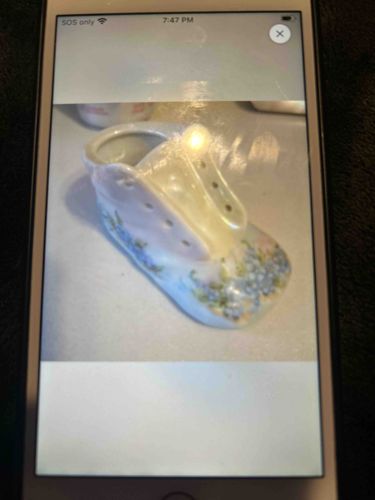
This item is a decorative porcelain baby bootie, likely intended to be used as a small planter or vase. It is characterized by its glossy white glaze and delicate hand-painted floral embellishments. The bootie is shaped like a miniature high-top shoe, featuring discernible eyelets along the sides, though no laces are present or depicted. The primary decoration consists of clusters of small blue and green flowers, possibly forget-me-nots, which are concentrated around the toe and heel areas of the bootie. The painting appears to be applied with a soft brushstroke technique, giving it a somewhat watercolor-like appearance. The interior of the bootie is unglazed or has a lighter, less reflective glaze, and it has an open top suitable for holding small items or a single flower. There are no immediate visible signs of cracks, chips, or significant wear on the exterior. The surface maintains a good sheen, suggesting an intact glaze. The craftsmanship indicates a mass-produced decorative item, possibly from the mid-20th century to late 20th century, given its style and the nature of the floral painting. There are no visible maker's marks or signatures from the provided image. Its small size, typical for similar decorative porcelain items, makes it suitable for a mantelpiece or a nursery decor. The overall condition appears good, with no obvious damage that would detract from its aesthetic appeal.
AI Appraisal Report
Based on my visual examination of the Porcelain Baby Bootie Planter/Vase, it appears to be in very good condition with a glossy white glaze and delicate hand-painted floral embellishments. There are no immediate visible signs of cracks, chips, or significant wear on the exterior, and the surface maintains a good sheen, indicating an intact glaze. The craftsmanship suggests a mass-produced decorative item, likely from the mid to late 20th century. The style of the floral painting is consistent with items from this period. I see no maker's marks or signatures, which is common for mass-produced decorative ceramics of this type.
Market conditions for such items are generally modest. Comparables in the online marketplace (e.g., Etsy, eBay) for similar vintage porcelain baby bootie planters, especially those without notable maker's marks or historical significance, typically range from $8 to $30. Demand for these specific items is low to moderate, driven primarily by collectors of vintage nursery decor or small decorative objects, rather than rarity. The lack of a known manufacturer or unique artistry limits its appeal to a broader collecting base.
Factors significantly impacting value include its good condition, but negatively affected by its mass-produced nature and absence of a known maker. The hand-painted flowers add a touch of charm, distinguishing it slightly from plain examples. However, the lack of provenance or a unique design limits its valuation.
It is crucial to note the limitations of appraising from images alone. Without physical inspection, I cannot definitively verify the authenticity of the material (e.g., porcelain vs. ceramic), inspect the interior for hidden flaws or repairs, or check for subtle crazing or wear not visible in photographs. An in-person examination would allow for tactile assessment, a thorough inspection of all surfaces, and the use of a magnifying glass for detailed flaw detection. Provenance documentation, if available, could provide additional historical context, but is unlikely for this type of item. Scientific testing is generally not cost-effective or necessary for decorative ceramics of this value.