AI estimate as of October 3, 2025 · verify with a professional before acting
AI-Generated · Verify before acting
Everything on this page is generated by AI for informational purposes only. AI can make mistakes — the AI may misidentify items or misattribute them (artist, maker, brand, designer, origin, era). This is not an official valuation and should not be used for insurance, sale, tax, estate, legal, or lending purposes — or any decision requiring a certified appraisal. It is not an authoritative claim about any person, brand, or rights holder — do not share or rely on it as a factual statement about a third party. Always consult qualified professionals before making financial decisions.
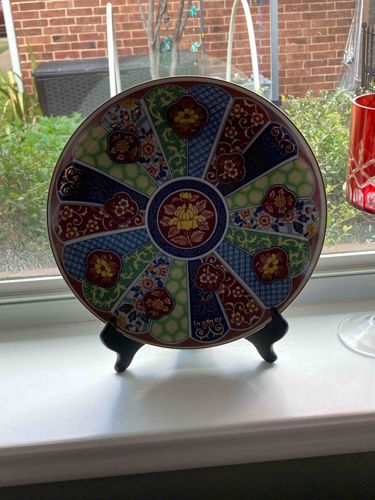
This is a circular decorative plate, likely made of porcelain or ceramic, showcasing a vibrant and intricate Imari-style pattern. The plate features a central medallion with a prominent yellow flower, possibly a chrysanthemum or peony, surrounded by a dark blue band with white geometric motifs. Radiating outwards from this center are numerous wedge-shaped panels, each filled with distinct patterns and colors. These panels alternate between floral designs, geometric patterns like cross-hatching or diamond grids, and scrollwork, predominantly in rich hues of red, dark blue, green, and a lighter, almost peach color. Some panels display stylized clusters of flowers and leaves, while others feature repeating geometric tessellations. The rim of the plate appears to have a thin gold-colored band, suggesting a gilded edge, which adds to its decorative appeal. The colors are robust and well-saturated, indicative of an overglaze enamel decoration technique typical of Imari ware. No visible chips, cracks, or repairs are apparent from the provided image, and the surface appears glossy and well-maintained. The craftsmanship suggests a commercially produced item, likely for decorative display rather than daily use, given its elaborate design. While a precise age is difficult to determine without maker's marks, the style points to a 20th-century production, possibly mid to late 20th century, as a continuation of traditional Japanese ceramic art. The plate is currently displayed on a simple black plastic or metal plate stand, which is not part of the item itself.
AI Appraisal Report
Based on my visual examination of the provided image, this circular decorative plate is a vibrant example of the Imari-style, likely porcelain or ceramic, featuring a complex pattern of a central yellow floral medallion encircled by numerous wedge-shaped panels. These panels are richly decorated with alternating floral and geometric motifs in characteristic Imari colors: red, dark blue, green, and a peachy tone, all finished with what appears to be a gilded rim. The colors are well-saturated, consistent with overglaze enamel decoration. The condition appears excellent, with no visible chips, cracks, or repairs, and the surface maintains a glossy sheen, indicating good maintenance.
Authenticity, based solely on visual inspection, suggests this is a commercially produced decorative item. The design is a continuation of traditional Japanese ceramic art, and the overall execution, while detailed, points to a 20th-century production, possibly mid to late 20th century. This aligns with many decorative Imari-style pieces produced for export and interior décor.
In terms of market conditions, decorative Imari-style plates from the 20th century are relatively common. While attractive, they are not typically rare, and there is a steady but not exceptionally high demand for them among collectors of decorative arts or those furnishing period-appropriate interiors. Comparable pieces of similar age and quality tend to sell in the $50 to $100 range in online marketplaces and antique shops. Factors influencing this valuation include the excellent visual condition and attractive design, balanced against its probable 20th-century decorative origin rather than being an antique Edo or Meiji period piece.
A significant limitation in this appraisal is the verification of authenticity from an image alone. Without examining the physical item, I cannot confirm the exact ceramic body, presence of maker's marks, or the true age. An in-person examination would allow for inspection of the footrim, glaze composition, and any subtle firing imperfections for a more precise dating. Provenance documentation, such as original sales receipts or family history, would also be invaluable. Scientific testing (e.g., thermoluminescence dating) could definitively determine age but is usually reserved for higher-value, historically significant pieces.