Vintage Silver-Plated Twin-Handled Sugar Bowl or Trophy Cup
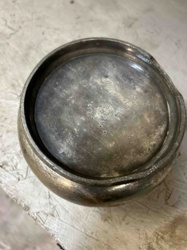
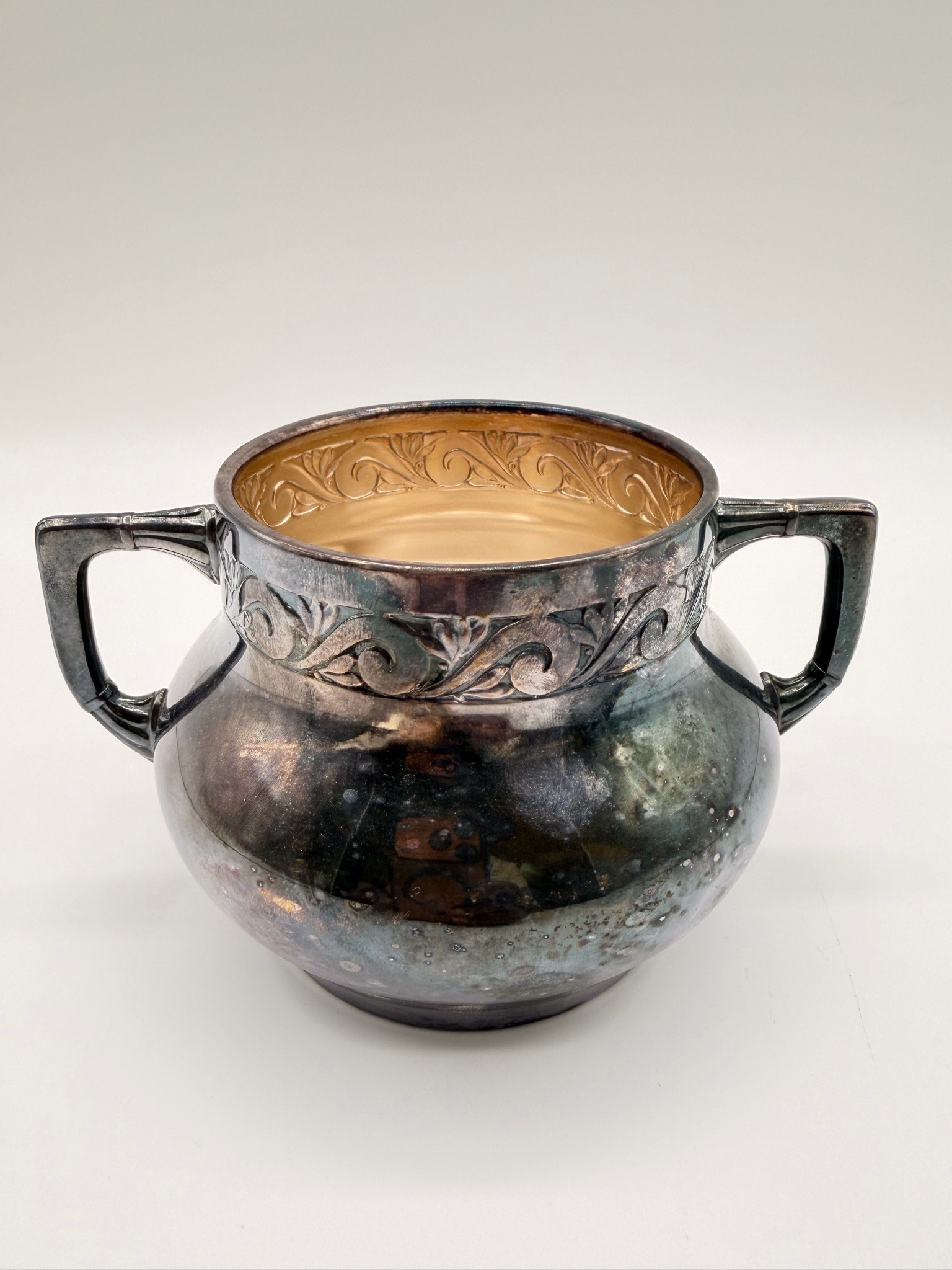
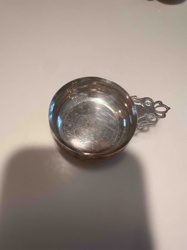
This is a vintage silver-plated hollowware vessel, likely a double-handled sugar bowl from a tea service or a small commemorative trophy cup. The piece features a bulbous, compressed globular body tapering upward to a wide, open rim decorated with an ornate repoussé or chased band of scrolling acanthus leaves and floral motifs. This decorative band is mirrored on the interior of the rim, suggesting heavy gold-wash or 'vermeil' lining intended to prevent corrosion from acidic contents. The item is fitted with two angular, D-shaped handles featuring decorative knuckle-grasps. The construction appears to be silver-plate over a base metal like copper or brass, evidenced by the characteristic heavy, dark tarnish and iridescent patina covering the exterior. The surface shows significant oxidation, spotting, and 'pitting' common with age, particularly on the lower belly. While no maker's marks are visible on the exterior, the style is consistent with late Victorian or early 20th-century Neo-Classical Revival aesthetics (circa 1890-1920). The craftsmanship of the embossed frieze is of good quality, though the overall condition is as-found with heavy atmospheric tarnish that obscuring the original bright finish.
AI-Generated Appraisal Disclaimer
Estimated Value
$45 - $75
Basic Information
Category
Antique Silver & Hollowware
Appraised On
April 20, 2026
Estimated Value
$45 - $75
Item Description
This is a vintage silver-plated hollowware vessel, likely a double-handled sugar bowl from a tea service or a small commemorative trophy cup. The piece features a bulbous, compressed globular body tapering upward to a wide, open rim decorated with an ornate repoussé or chased band of scrolling acanthus leaves and floral motifs. This decorative band is mirrored on the interior of the rim, suggesting heavy gold-wash or 'vermeil' lining intended to prevent corrosion from acidic contents. The item is fitted with two angular, D-shaped handles featuring decorative knuckle-grasps. The construction appears to be silver-plate over a base metal like copper or brass, evidenced by the characteristic heavy, dark tarnish and iridescent patina covering the exterior. The surface shows significant oxidation, spotting, and 'pitting' common with age, particularly on the lower belly. While no maker's marks are visible on the exterior, the style is consistent with late Victorian or early 20th-century Neo-Classical Revival aesthetics (circa 1890-1920). The craftsmanship of the embossed frieze is of good quality, though the overall condition is as-found with heavy atmospheric tarnish that obscuring the original bright finish.
Get Your Items Appraised
Instant estimates of your treasures with AI-powered instant appraisals