AI Appraisal Estimate

AI-generated estimates · not official valuations

From the user

What was submitted

Photo and notes provided by the user — not generated by AI

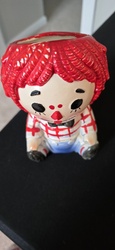
Submitted item photo
Submitted photo · June 17, 2026

User's notes

No additional notes provided.

AI analysis below

AI appraisal

AI analysis & estimate

AI-Generated · Verify before acting

Everything below is generated by AI for informational purposes only. AI can make mistakes — the AI may misidentify items or misattribute them (artist, maker, brand, designer, origin, era). This is not an official valuation and should not be used for insurance, sale, tax, estate, legal, or lending purposes — or any decision requiring a certified appraisal. It is not an authoritative claim about any person, brand, or rights holder — do not share or rely on it as a factual statement about a third party. Always consult qualified professionals before making financial decisions.

Read the full disclaimer

AI Identification

·Not independently authenticated·Verify before acting

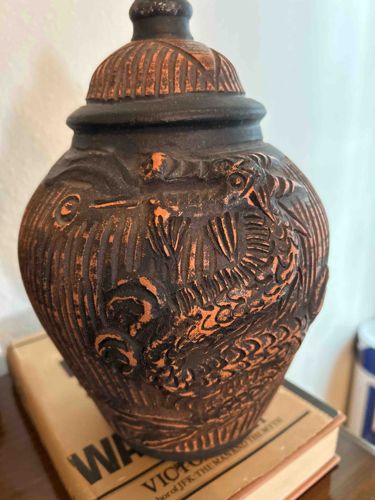
Relief-Decorated Red Clay Ginger Jar with Dragon Motif

Decorative Ceramics

AI Estimated Value

·Not an official valuation·Verify before acting

$45.00 - $75.00

As of June 17, 2026

AI Item Analysis

·AI can make mistakes·Verify before acting
This item is a decorative lidded jar, likely a ginger jar, crafted from terracotta-toned red clay and features a high-relief carved or molded design. The central aesthetic element is an East Asian style dragon, specifically a lung dragon, which wraps around the bulbous body of the vessel. The dragon is depicted with scaly skin, sharp claws, and a flowing mane, set against a background of vertical striations that suggest motion or water. The jar is finished with a dark brown or matte black slip or wash that predominantly rests in the recessed areas, creating a high-contrast 'antique' effect that emphasizes the raised orange-red clay details. The lid is domed and matching in style, featuring similar vertical ribbing and a simple rounded finial. In terms of condition, there are visible surface abrasions and paint/slip loss throughout, most notably on the raised parts of the dragon and the lid's finial, exposing the light-colored clay underneath. These chips suggest a mid-20th-century decorative piece, possibly an export item from East Asia or a 'Tiki-era' decor object. The craftsmanship shows mass-produced qualities with some hand-finishing in the relief work. There are no visible maker's marks in this view, and the overall patina appears to be a mix of intentional distressing and genuine shelf wear.
AI Appraisal Report

·AI can make mistakes·Verify before acting
Based on my visual examination, I identify this item as a mid-20th-century decorative ginger jar, likely produced in Japan or Taiwan for the Western export market. The piece is constructed from a common red earthenware clay with a thick, relief-molded 'dragon and wave' motif. The high-contrast finish is achieved through a localized glaze or slip wash, intentionally wiped away on the raised surfaces to simulate age. The 'dragon' styling aligns with the 'Orientalia' and 'Tiki' design trends popular in the 1950s and 60s. Regarding condition, I observe significant surface abrasions and chipping, particularly on the lid finial and the dragon’s mane. The chips reveal a lighter interior body, confirming the use of a pigmented slip rather than a true high-fire glaze. These defects, while common for cold-painted or slip-washed ceramics of this era, detract from the display value. Market demand for such pieces is currently moderate, fueled primarily by vintage home decor enthusiasts rather than fine art collectors. Comparables on the secondary market (eBay, Etsy) typically sell in the sub-$100 range due to the mass-produced nature of the slip-casting. Limitations: This appraisal is based solely on digital images. Without physical handling, I cannot confirm the presence of obscured maker's marks on the underside or identify repair work concealed by the heavy patina. A full authentication would require an in-person inspection of the interior clay body porosity and a check for any 'made in' stamps or paper labels, which would further clarify its country of origin and specific manufacturing firm.

Get your items appraised

Instant estimates of your treasures with AI-powered appraisals

Browse More Appraisals