AI estimate as of July 30, 2025 · verify with a professional before acting
AI-Generated · Verify before acting
Everything on this page is generated by AI for informational purposes only. AI can make mistakes — the AI may misidentify items or misattribute them (artist, maker, brand, designer, origin, era). This is not an official valuation and should not be used for insurance, sale, tax, estate, legal, or lending purposes — or any decision requiring a certified appraisal. It is not an authoritative claim about any person, brand, or rights holder — do not share or rely on it as a factual statement about a third party. Always consult qualified professionals before making financial decisions.
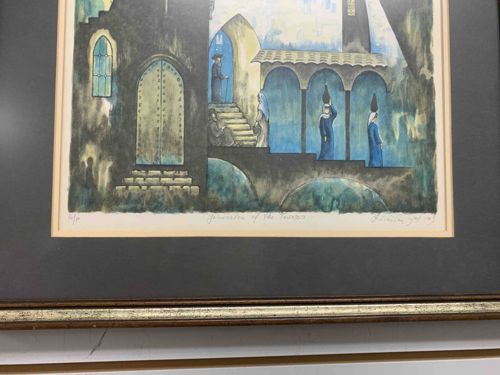
This is a framed limited edition art print, likely a lithograph or serigraph, depicting an architectural scene with figures. The artwork features a muted color palette dominated by blues, greens, and browns, with touches of yellow and beige. The composition shows multiple levels, including a prominent large wooden door with visible studs, archways, and staircases. Several figures are visible within the architectural setting; one figure appears to be seated on steps, while others, possibly robed, are standing or walking under arches, some wearing distinctive tall, conical hats. The overall style suggests a historical or fantasy setting, with a somewhat somber or contemplative mood. The print itself has a visible white border or matting, on which handwritten details are present. In the lower left corner, '6/50' is written, indicating it is the 6th print out of a limited edition of 50. In the center, there appears to be a title, 'Guardians of the Temple' (though the last word is slightly obscured, 'Temple' seems plausible). To the right, there is a signature that reads 'Solomon 94', suggesting the artist is Solomon and the print was created in 1994. The print is framed under glass, with a dark, possibly black, matboard surrounding the print, and encased in a wooden frame. The frame has a decorative gold-toned inner edge with an etched or carved pattern, and a darker, possibly distressed, outer edge. Visible condition issues include minor scuffs or wear on the frame, particularly noticeable in the bottom left corner where a light scuff or mark is present on the dark frame. The glass appears clear, and the print itself seems to be in good condition with no immediate visible damage or discoloration.
AI Appraisal Report
Upon examining the provided images of this framed art print, my assessment is as follows. The piece, titled 'Guardians of the Temple', is a limited edition print, numbered 6 out of a small edition of 50. It is signed by the artist 'Solomon' and dated '94. Based on the style and era, it is likely a lithograph or serigraph. The print itself appears to be in good condition, with no visible fading, staining, or damage. The frame, while appropriate for the piece with its dual-tone wood and decorative inner edge, shows minor cosmetic wear, such as scuffs, which is typical for its age but does not significantly detract from the value of the artwork itself.
The value is primarily driven by its status as a small, limited edition, which enhances its rarity. However, the artist 'Solomon' from 1994 does not appear to have an established, high-value secondary market presence, placing this piece in a decorative or emerging artist category. Current market conditions for lesser-known but skilled artists often see values determined by aesthetic appeal, size, and edition rarity rather than auction records.
It is crucial to note the limitations of this appraisal. Without physical inspection, I cannot definitively authenticate the signature or confirm the printmaking technique (e.g., lithograph vs. serigraph vs. giclée). True authentication would require de-framing the piece to examine the paper, potential watermarks, and printing details under magnification. Furthermore, provenance documentation, such as a certificate of authenticity (COA) or original purchase receipt, would be necessary to fully substantiate its origin and value.