AI estimate as of July 27, 2025 · verify with a professional before acting
AI-Generated · Verify before acting
Everything on this page is generated by AI for informational purposes only. AI can make mistakes — the AI may misidentify items or misattribute them (artist, maker, brand, designer, origin, era). This is not an official valuation and should not be used for insurance, sale, tax, estate, legal, or lending purposes — or any decision requiring a certified appraisal. It is not an authoritative claim about any person, brand, or rights holder — do not share or rely on it as a factual statement about a third party. Always consult qualified professionals before making financial decisions.
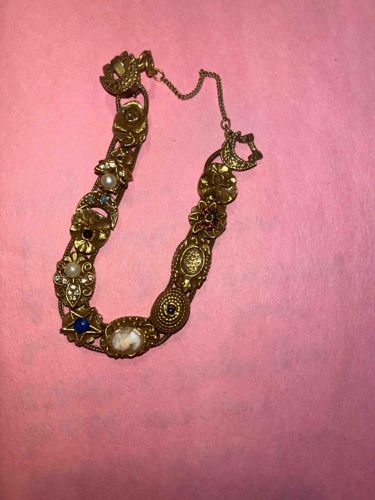
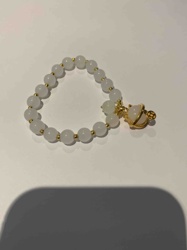
This is a vintage multi-charm link bracelet, likely crafted from a brass or gold-plated base metal, due to its aged, somewhat dulled golden hue that suggests a patina commensurate with age. The bracelet features an intricate design composed of various shaped links, each adorned with a distinct ornamental element. These elements include floral motifs, some with central stone inlays (e.g., a dark red cabochon, a blue cabochon resembling lapis lazuli, a pearl, and various clear rhinestones), as well as a notable carved cameo, possibly shell or resin, depicting a classical female profile. Other links display textured metalwork, such as a raised star shape with a central blue cabochon and an oval link with an intricate pressed or embossed design, possibly a coat of arms or a similar decorative emblem. The construction appears to be a series of hinged links, allowing flexibility for wear, and it fastens with a delicate chain and spring-ring clasp, which also features an additional decorative charm that might be a stylized crescent moon or an abstract shape. The overall aesthetic points to a Victorian Revival or Edwardian-inspired period, possibly mid-20th century, given the eclectic mix of motifs and materials commonly found in costume jewelry of that era. Visible condition issues include a general dulling of the metal, consistent with natural aging and patination. Some rhinestones may show minor discoloration or dullness, and the pearl might exhibit slight surface wear. The craftsmanship, while detailed, aligns with mass-produced costume jewelry rather than fine artisan work, indicated by the uniformity of the stamped elements and the types of materials used.
AI Appraisal Report
Upon examining the image of this vintage multi-charm link bracelet, I note its eclectic design, characteristic of Victorian Revival or Edwardian-inspired costume jewelry, likely mid-20th century. The base metal appears to be brass or gold-plated, evidenced by the aged, dulled golden hue and patina. The various charms, including floral motifs with central stone inlays (red and blue cabochons, pearl, clear rhinestones), a carved cameo, and textured metalwork, suggest mass-produced costume jewelry rather than fine artisan work.
In terms of condition, the metal shows general dulling and patination consistent with age. Some rhinestones may exhibit minor discoloration, and the pearl might have slight surface wear. These are typical signs of aging for pieces of this type and do not significantly detract from its appeal as a vintage item.
Regarding market conditions, vintage costume jewelry, particularly pieces with unique charm configurations, sees moderate demand. This bracelet's charm-laden design is appealing to collectors of period-specific costume jewelry. Rarity is low as similar mass-produced pieces were common.
Factors significantly impacting value include its status as costume jewelry, utilizing non-precious metals and imitation stones. Its appeal lies in its aesthetic and historical representation rather than intrinsic material value.
Without physical inspection, I cannot definitively confirm the material composition of the stones (e.g., whether the blue cabochon is genuine lapis lazuli or an imitation, or the pearl's origin), nor can I ascertain the exact material of the cameo (shell vs. resin). A closer in-person examination, including detailed magnification and potentially specific gravity tests for stones, would be needed for full authentication of materials. Provenance documentation, if available, would also aid in establishing its precise age and origin beyond visual assessment.