AI Appraisal Estimate

AI-generated estimates · not official valuations

From the user

What was submitted

Photo and notes provided by the user — not generated by AI

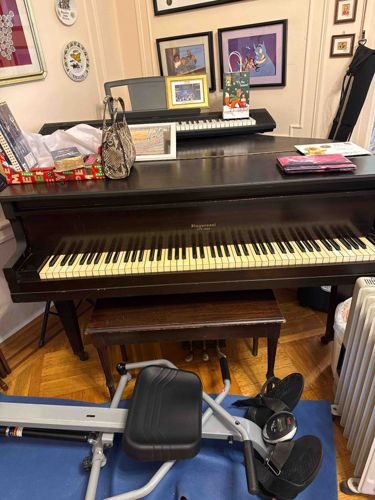
Submitted item photo
Submitted photo · June 6, 2026

User's notes

No additional notes provided.

AI analysis below

AI appraisal

AI analysis & estimate

AI-Generated · Verify before acting

Everything below is generated by AI for informational purposes only. AI can make mistakes — the AI may misidentify items or misattribute them (artist, maker, brand, designer, origin, era). This is not an official valuation and should not be used for insurance, sale, tax, estate, legal, or lending purposes — or any decision requiring a certified appraisal. It is not an authoritative claim about any person, brand, or rights holder — do not share or rely on it as a factual statement about a third party. Always consult qualified professionals before making financial decisions.

Read the full disclaimer

AI Identification

·Not independently authenticated·Verify before acting

Stuyvesant Baby Grand Piano

Musical Instruments

AI Estimated Value

·Not an official valuation·Verify before acting

$800 - $1,500

As of June 6, 2026

AI Item Analysis

·AI can make mistakes·Verify before acting
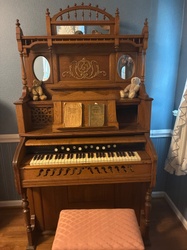
This is a vintage baby grand piano manufactured by the Stuyvesant Piano Co. of New York. The instrument features a classic dark mahogany or ebony wood finish with a satin sheen. Its physical construction includes a standard 88-key keyboard, though the keys exhibit significant yellowing, suggesting they are likely original ivory or an older celluloid composite. Centered above the keys is the maker's mark 'Stuyvesant, NEW YORK' in gold metallic lettering. The piano is supported by tapered spade legs, typical of the early 20th-century style (circa 1910-1930). Visible condition issues include minor surface scratches and scuffing on the wood case, particularly along the edges and near the legs. The fallboard and lid show some dust accumulation and surface wear consistent with age and domestic use. The piano is accompanied by a matching rectangular wooden bench with similar finish wear. The presence of a radiator nearby and its placement on a wooden parquet floor suggests potential exposure to humidity fluctuations, which may affect the internal soundboard and tuning stability. The craftsmanship appears robust, reflecting the solid manufacturing standards of the Aeolian Company era, under which the Stuyvesant brand operated.
AI Appraisal Report

·AI can make mistakes·Verify before acting
Based on my visual inspection, this Stuyvesant baby grand piano is an authentic product of the Aeolian Company era, likely dating between 1915 and 1925. The tapered spade legs and gold-leaf branding are consistent with the period's craftsmanship. The mahogany/ebony finish remains largely intact, though typical surface scuffs and age-related wear are present. The yellowed keys suggest original ivory, which adds historical character but carries potential interstate trade restrictions. The proximity to a radiator is a significant concern; heat sources cause rapid expansion and contraction, often resulting in soundboard cracks or a loose pinblock, which are costly to repair. The market for vintage baby grands from mid-tier manufacturers like Stuyvesant is currently soft. While the Aeolian build quality is respectable, Stuyvesant does not command the premium prices associated with 'tier-one' brands like Steinway or Mason & Hamlin. Most buyers in this category are seeking furniture pieces rather than professional-grade performance instruments. Comparable sales for unrestored Stuyvesant units typically fall within the $500–$2,000 range depending on mechanical functionality. Several limitations exist in this remote appraisal. I cannot verify the integrity of the soundboard, the tightness of the tuning pins, or the presence of moth damage in the hammers and felts without a physical inspection. A full valuation would require a technician's evaluation of the internal action and a serial number verification to confirm the exact production year. Furthermore, the ability of the piano to hold a standard A440 pitch is the primary driver of value; if the pinblock is failed, the item's value would drop to a nominal 'salvage' or decorative price of $100–$300.

Get your items appraised

Instant estimates of your treasures with AI-powered appraisals

Browse More Appraisals