AI estimate as of October 18, 2025 · verify with a professional before acting
AI-Generated · Verify before acting
Everything on this page is generated by AI for informational purposes only. AI can make mistakes — the AI may misidentify items or misattribute them (artist, maker, brand, designer, origin, era). This is not an official valuation and should not be used for insurance, sale, tax, estate, legal, or lending purposes — or any decision requiring a certified appraisal. It is not an authoritative claim about any person, brand, or rights holder — do not share or rely on it as a factual statement about a third party. Always consult qualified professionals before making financial decisions.
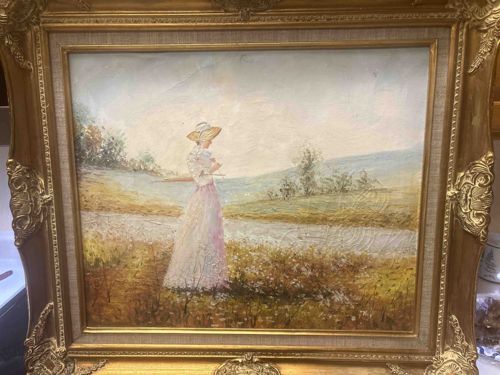
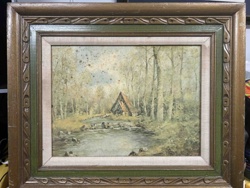
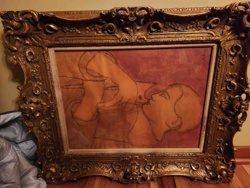
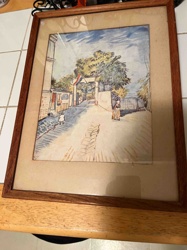
This item is an oil painting depicting a lone woman in a serene, natural landscape. The woman, rendered in what appears to be an impressionistic style, is seen from a side/rear angle, wearing a light-colored, possibly white or pink, long dress and a wide-brimmed straw hat. She is holding what might be a book or a parasol in her hands. The landscape features a body of water (possibly a river or lake) in the mid-ground, with fields of wild flowers in the foreground and distant hills or trees under a light, possibly cloudy, sky. The brushstrokes are visibly textured and robust, particularly in the grass and floral elements, suggesting impasto techniques. The overall color palette is muted with earthy tones of greens, browns, and golds, contrasted with the lighter hues of the woman's attire and the sky. The painting is housed in a substantial, ornate gilded frame, likely made of wood with gesso and gold leaf or gold paint. The frame features intricate rococo-style scrolling and floral motifs at the corners and along the edges, adding to the decorative appeal of the piece. While no specific artist's signature or maker's marks are visible in the provided image, the style suggests a late 19th to early 20th-century aesthetic, possibly influenced by Impressionism or Post-Impressionism. Visible condition issues on the painting include some surface dirt and possible crazing or cracking in the paint layer, particularly noticeable in the sky area. The frame exhibits some wear typical of its age, such as minor chips to the gilding, especially on the raised decorative elements, and possibly some darkening or tarnishing of the gold finish. The quality of the brushwork is amateur to semi-professional, focusing more on atmospheric effect than sharp detail.
AI Appraisal Report
Based on my visual examination of the provided image, this Impressionistic Painting of a Woman in a Landscape, housed in a gilded frame, exhibits characteristics consistent with late 19th to early 20th-century aesthetics. The brushwork, while expressive and atmospheric, leans towards an amateur to semi-professional execution, lacking the distinctive hand and mastery of a recognized Impressionist master. Authenticity cannot be definitively confirmed from an image alone; however, given the quality, it is highly unlikely to be by a major artist. Without a visible signature or provenance documentation, it is considered an decorative period piece rather than a collectible work by a known artist.
The condition of the painting shows surface dirt and noticeable crazing/cracking, particularly in the sky, which are common signs of age. The ornate gilded frame, likely wood with gesso and gold leaf/paint, presents typical wear with chips to the gilding and potential tarnishing. These condition issues, while not severe enough to deter all potential buyers, do impact value by requiring potential restoration.
Market conditions for unsigned decorative Impressionistic-style works are generally stable but not exceptionally strong. Comparable works in this quality and condition range often sell for a few hundred dollars. Demand exists for aesthetically pleasing period pieces, but rarity is low for unsigned works of this caliber. Factors significantly impacting value are the unknown artist, the decorative rather than fine art quality of execution, and the visible condition issues.
For full authentication and a more precise valuation, an in-person examination would be crucial to assess the paint layer, canvas, and frame structure directly. Scientific analysis (e.g., pigment analysis, UV light examination) could provide insights into age and potential overpainting. Provenance documentation, if available, linking the piece to a specific artist or collection, would be paramount for establishing higher value and authenticity.