AI Appraisal Estimate

AI-generated estimates · not official valuations

From the user

What was submitted

Photo and notes provided by the user — not generated by AI

Submitted item photo
Submitted photo · May 19, 2026

User's notes

No additional notes provided.

AI analysis below

AI appraisal

AI analysis & estimate

AI-Generated · Verify before acting

Everything below is generated by AI for informational purposes only. AI can make mistakes — the AI may misidentify items or misattribute them (artist, maker, brand, designer, origin, era). This is not an official valuation and should not be used for insurance, sale, tax, estate, legal, or lending purposes — or any decision requiring a certified appraisal. It is not an authoritative claim about any person, brand, or rights holder — do not share or rely on it as a factual statement about a third party. Always consult qualified professionals before making financial decisions.

Read the full disclaimer

AI Identification

·Not independently authenticated·Verify before acting

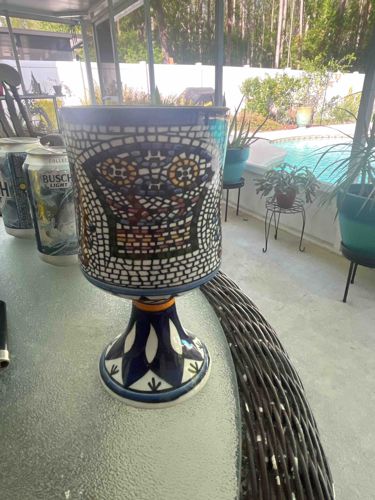
Talavera Style Ceramic Mosaic-Pattern Goblet

Decorative Ceramics and Art Pottery

AI Estimated Value

·Not an official valuation·Verify before acting

$45.00 - $75.00

As of May 19, 2026

AI Item Analysis

·AI can make mistakes·Verify before acting
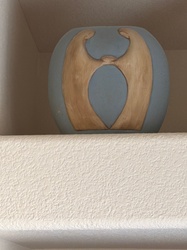
This item is a decorative ceramic goblet or chalice, likely of Mexican or Mediterranean origin, featuring a complex hand-painted mosaic-grid aesthetic. The vessel consists of a large cylindrical cup atop a pedestal base. The body of the cup is adorned with a dense, white-ground grid pattern mimicking tiles, punctuated by a central figurative motif in shades of blue, ochre, and dark brown. The motif appears to represent a stylized face or mask, a common theme in folk art. The stem is cinched with an orange band, leading to a flared base decorated with bold navy blue petals and white geometric shorthand markings. The entire piece is finished with a high-gloss lead-free glaze. Regarding condition, the piece shows minimal surface wear, though visible crazing (fine cracking of the glaze) is likely present due to the nature of fired earthenware. The craftsmanship indicates hand-thrown and hand-painted artistry rather than mass production, suggesting it may be a mid-to-late 20th-century artisan piece or a contemporary high-quality souvenir. There are no immediately visible maker's marks from this angle, but the weight and thickness of the rim suggest a sturdy, earthenware construction typical of regional pottery traditions.
AI Appraisal Report

·AI can make mistakes·Verify before acting
I have examined the digital representation of the Talavera-style ceramic goblet. Visually, the piece presents a striking mosaic-grid aesthetic across a substantial earthenware form. My inspection reveals a high-gloss glaze over hand-applied pigments. The 'crazing' noted is consistent with traditional low-fire earthenware, where the clay body and glaze expand at different rates. While this adds a vintage character, it indicates the piece is not vitrified and should likely be restricted to decorative use to avoid liquid seepage or bacterial growth. Technically, the craftsmanship is indicative of high-quality workshop production, likely from the Puebla region of Mexico or a specialized Mediterranean studio. The absence of a visible 'denominación de origen' or a signature on the footring limits its standing as a collector’s 'Signed Artisan' piece, placing it more comfortably in the category of 'contemporary high-end folk art.' The market for non-antique Talavera-style ceramics is currently stable, though saturated. Comparables for unsigned, mid-sized decorative vessels typically sell within the $40 to $80 range at regional auction houses or specialized boutiques. The unique mask motif provides a slight premium over generic floral patterns. Limitations: My assessment is based solely on visual data. A physical inspection is required to determine the weight (checking for air pockets), the presence of lead in the glaze (via XRF testing), and to find any recessed maker’s marks. To professionally authenticate this as a specific historic workshop production (such as Uriarte), provenance documentation or a confirmed studio stamp would be essential. Without these, the value remains tied to its aesthetic and functional appeal rather than its heritage name.

Get your items appraised

Instant estimates of your treasures with AI-powered appraisals

Browse More Appraisals