AI Appraisal Estimate

AI-generated estimates · not official valuations

From the user

What was submitted

Photo and notes provided by the user — not generated by AI

Submitted item photo
Submitted photo · May 27, 2026

User's notes

No additional notes provided.

AI analysis below

AI appraisal

AI analysis & estimate

AI-Generated · Verify before acting

Everything below is generated by AI for informational purposes only. AI can make mistakes — the AI may misidentify items or misattribute them (artist, maker, brand, designer, origin, era). This is not an official valuation and should not be used for insurance, sale, tax, estate, legal, or lending purposes — or any decision requiring a certified appraisal. It is not an authoritative claim about any person, brand, or rights holder — do not share or rely on it as a factual statement about a third party. Always consult qualified professionals before making financial decisions.

Read the full disclaimer

AI Identification

·Not independently authenticated·Verify before acting

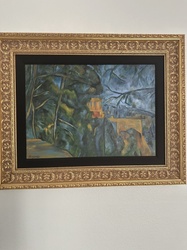
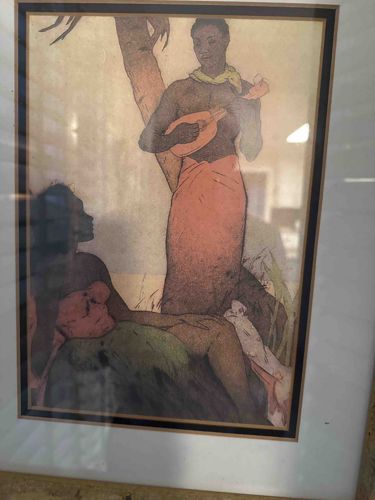
Framed Print of Paul Gauguin's 'The Ukulele Player' (Haere Pape)

Fine Art Prints and Reproductions

AI Estimated Value

·Not an official valuation·Verify before acting

$40 - $80

As of May 27, 2026

AI Item Analysis

·AI can make mistakes·Verify before acting
This item is a framed color print of the famous 19th-century Post-Impressionist work 'The Ukulele Player' (also known as Haere Pape), originally created by Paul Gauguin during his time in Tahiti. The artwork depicts three Polynesian figures in a tropical setting; one woman stands playing a stringed instrument, while two others rest below near a palm tree. The color palette is characteristic of Gauguin's Tahitian period, featuring earthy browns, sunset oranges, muted greens, and soft yellows. The print appears to be a lithographic or high-quality offset reproduction on paper. It is housed in a modern professional framing treatment consisting of a multi-layered mat (white, black, and gold/tan) and what appears to be a metallic or gilded wood frame. The construction shows a clean, modern aesthetic indicative of late 20th-century framing. The condition appears fair to good, though there is visible light glare on the glass, making it difficult to assess for foxing or fading; however, some slight discoloration to the matting suggests age. There are no immediate signs of a signature or limited edition numbering visible in the current view, suggesting this is a decorative open-edition reproduction. The style captures the Primitivist movement of the 1890s, focused on stylized forms and flat fields of color.
AI Appraisal Report

·AI can make mistakes·Verify before acting
Based on my visual examination of this framed piece, I have identified it as a decorative, open-edition reproduction of Paul Gauguin's 1892 masterpiece, 'Haere Pape' (The Ukulele Player). The print appears to be a standard offset lithograph rather than a fine art serigraph or giclée, likely produced in the late 20th century. The absence of a visible plate signature, pencil signature, or edition numbering strongly indicates this was mass-produced for the home decor market rather than the fine art collector market. The framing handling is professional, featuring a triple-mat design that likely dates to the 1980s or 1990s. While the frame adds structural value, the print itself holds minimal independent monetary worth. The condition appears to be generally good, though I noted slight oxidation or yellowing on the matting, which is consistent with acid-burn from non-archival materials typical of mid-level framing from that era. I cannot definitively assess the print for fading without removing it from the glass, but the colors seem reasonably retained. In the current secondary market, value is derived almost entirely from the decorative utility of the frame and the enduring popularity of Gauguin's Tahitian imagery. Similar items frequently appear in consignment shops and online marketplaces. Comparables for framed, open-edition museum prints of this size generally sell in the $40 to $80 range, largely dependent on the condition of the frame. To achieve a value higher than this, I would need to find physical evidence of this being a specifically rare exhibition poster or a higher-quality vintage collotype, neither of which is apparent here.

Get your items appraised

Instant estimates of your treasures with AI-powered appraisals

Browse More Appraisals