AI estimate as of August 8, 2025 · verify with a professional before acting
AI-Generated · Verify before acting
Everything on this page is generated by AI for informational purposes only. AI can make mistakes — the AI may misidentify items or misattribute them (artist, maker, brand, designer, origin, era). This is not an official valuation and should not be used for insurance, sale, tax, estate, legal, or lending purposes — or any decision requiring a certified appraisal. It is not an authoritative claim about any person, brand, or rights holder — do not share or rely on it as a factual statement about a third party. Always consult qualified professionals before making financial decisions.
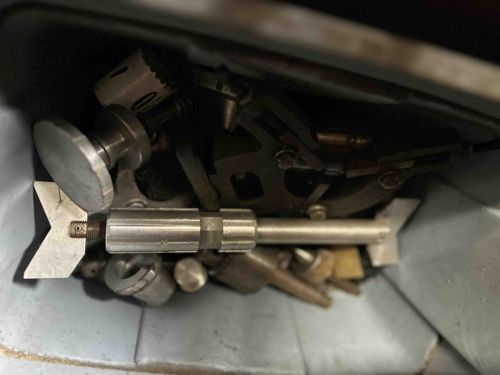
The image displays a collection of metal components, likely various parts and accessories for a specialized machine or for machining tasks. The most prominent item in the foreground is a precisely machined metallic rod with threaded ends and a knurled or grooved section in the middle. One end of this rod is attached to a flat, V-shaped or arrow-like piece of metal, which appears to be a specialized jig, stop, or measuring element. This V-shaped component is affixed via a small screw or bolt into the threaded end of the rod. The material of this primary component appears to be a light-colored metal, possibly aluminum, stainless steel, or a similar alloy, chosen for its strength and precision. The surface shows a brushed or matte finish, indicative of machining marks, with some minor scuffs and marks consistent with use or storage within a bin with other metal items. There are no obvious signs of significant corrosion or heavy damage, suggesting it has been reasonably well-maintained or is made of a corrosion-resistant material.
Behind this central piece, a chaotic assortment of other metal parts is visible. These include what looks like a hole saw with prominent teeth, various other cylindrical and irregularly shaped metal pieces, some with threaded sections, and what might be parts of a jig or fixture assembly. One round, flat-topped knob with a central shaft is also discernible, likely a control or adjustment knob. The overall impression is that of a toolbox or storage bin containing a mix of precision measurement tools, machine parts, and tooling accessories. The items appear to be mass-produced, likely from the mid-to-late 20th century or more recently, given the precision of the visible machining. The craftsmanship is utilitarian and precise, typical of industrial or workshop tools, prioritizing function over aesthetic appeal. There are no visible manufacturer's marks or signatures.
AI Appraisal Report
Upon visual examination of the provided image, I've assessed this assortment of machinist tools and jigs. The primary component, a precision machined metallic rod with a V-shaped end, appears to be in good, used condition. Its brushed or matte finish shows typical handling marks but no significant damage or corrosion, suggesting durable material like stainless steel or aluminum. The craftsmanship is indicative of functional, mass-produced industrial tooling, prioritizing utility and precision over aesthetics. The assorted metal parts in the background—including a hole saw, various cylindrical pieces, and a control knob—appear to be standard workshop accessories, also in used condition.
Authenticity: Based on the visual evidence, these items appear to be genuine machinist tools. However, without visible manufacturer's marks or signatures, definitive authentication of origin or specific brand is impossible from images alone. An in-person examination would allow for closer inspection of machining tolerances, material testing (e.g., specific alloy analysis), and a search for any minute identifying marks often found on precision tooling. Provenance documentation, such as purchase receipts or catalogs, would further aid in historical authentication.
Market Conditions & Comparables: The market for used machinist tools and accessories is generally robust among hobbyists, small workshops, and educational institutions. Individual components like the V-block and other assorted parts typically fetch moderate prices, often sold in lots. Similar used V-blocks or specialized jig components can range from $20 to $100+ depending on precision, brand, and material. The other miscellaneous parts are low-value individually.
Demand & Rarity: These are common, utilitarian tools, not considered rare. Demand is steady for functional, precision workshop items, but not exceptional given their commonality. The lack of specific branding or unique features limits any premium for rarity.
Factors Impacting Value: The primary factor impacting value is the utility and precision of the V-block/stop. Its condition is good, which maintains its usability. However, the lack of branding significantly limits its market appeal beyond pure functionality. The assortment of other parts adds some bulk but little significant value individually. The absence of a complete set or a known manufacturer reduces potential collectible value. The biggest limitation to a definitive appraisal is the inability to physically inspect the items, particularly to verify material composition, precise dimensions, and any hidden defects or wear not visible in the image.