AI estimate as of July 13, 2025 · verify with a professional before acting
AI-Generated · Verify before acting
Everything on this page is generated by AI for informational purposes only. AI can make mistakes — the AI may misidentify items or misattribute them (artist, maker, brand, designer, origin, era). This is not an official valuation and should not be used for insurance, sale, tax, estate, legal, or lending purposes — or any decision requiring a certified appraisal. It is not an authoritative claim about any person, brand, or rights holder — do not share or rely on it as a factual statement about a third party. Always consult qualified professionals before making financial decisions.
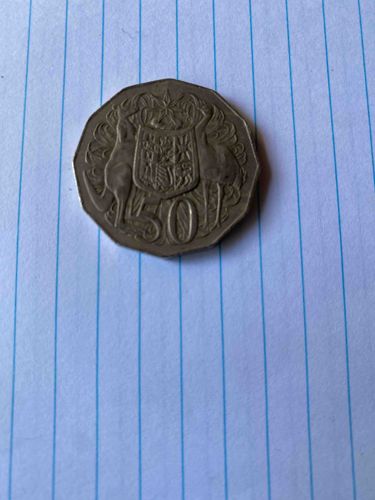
The item is an Australian 50 cent coin, identifiable by its distinctive dodecagonal (12-sided) shape and the visible reverse design. The coin appears to be made of a silver-colored cupro-nickel alloy, typical for this denomination. The visible side prominently features the Commonwealth Coat of Arms, which includes a shield held by a kangaroo and an emu, surmounted by the Commonwealth Star. Below the shield, the denomination '50' is clearly visible in large numerals. The surface of the coin shows signs of circulation, indicated by a slightly dull finish and some minor surface wear consistent with handling over time. There are no immediate signs of severe damage such as deep scratches, major dings, or corrosion, suggesting a generally good but circulated condition. The craftsmanship appears to be standard for a circulating Australian coin, with clear details on the coat of arms, though some of the finer lines in the shield might be slightly softened by wear. Without seeing the obverse, it's not possible to determine the exact year, but the design visible is consistent with 50 cent coins minted from 1969 onwards, following the initial round 50 cent coin. The dodecagonal shape itself is a notable feature, making it easily distinguishable from other denominations or coins from other countries. The edges appear intact, maintaining the multi-sided polygon shape.
AI Appraisal Report
Based on my visual examination of the provided image, I have assessed this Australian dodecagonal 50 Cent coin. The authenticity appears to be high; the design faithfully reproduces the Commonwealth Coat of Arms and the distinct dodecagonal shape, consistent with genuine Australian 50 cent coins minted from 1969 onwards. The strike quality, even with wear, suggests a legitimate minting process.
The condition of the coin is 'circulated good'. I observe a dull finish and some minor surface abrasions, particularly on the higher points of the design such as the shield and the '50' numerals. There are no signs of severe damage like deep gouges, heavy corrosion, or significant rim nicks, which is positive. However, the lack of original luster indicates it has seen considerable handling.
Regarding market conditions, these standard circulating 50 cent coins, particularly those from common years, are very readily available. The demand is generally low among serious collectors unless they are in uncirculated (UNC) condition or are specific commemorative issues. Without seeing the obverse to determine the year or any potential mint mark, it's difficult to ascertain if this is a more sought-after variety. Most general issue 50 cent coins, even in better circulated conditions, typically trade for little more than their face value. Rarity is not a factor for common circulating issues.
Factors significantly impacting value would be its condition (moving towards UNC), a rare key date, or a known error variety – none of which are evident from this image.
My primary limitation in this appraisal is the lack of a reverse image, which prevents me from identifying the specific year of mintage and the depiction of the reigning monarch, crucial information for precise valuation and identifying potential key dates or varieties. Furthermore, a physical inspection would allow me to assess the coin's weight, edge details, and overall tactile feel, which can further confirm authenticity and condition details. Microscopic examination could reveal subtle details of wear or potential alterations. Provenance documentation, while unlikely for such a common coin, would further solidify its history.