AI estimate as of September 29, 2025 · verify with a professional before acting
AI-Generated · Verify before acting
Everything on this page is generated by AI for informational purposes only. AI can make mistakes — the AI may misidentify items or misattribute them (artist, maker, brand, designer, origin, era). This is not an official valuation and should not be used for insurance, sale, tax, estate, legal, or lending purposes — or any decision requiring a certified appraisal. It is not an authoritative claim about any person, brand, or rights holder — do not share or rely on it as a factual statement about a third party. Always consult qualified professionals before making financial decisions.
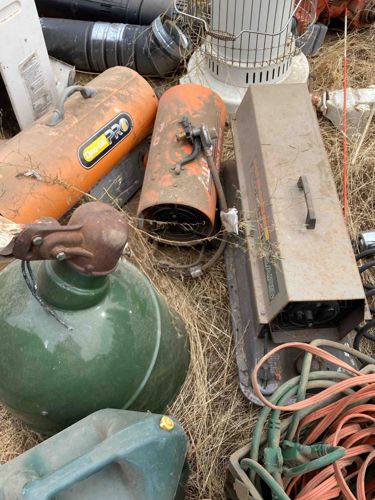
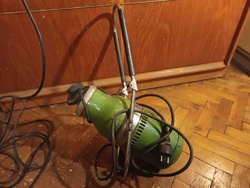
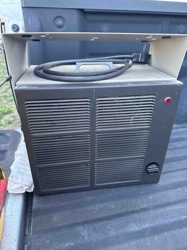
This image displays a collection of items typically found in a workshop or industrial setting, characterized by their functional design and robust construction. The most prominent items include two orange torpedo-style forced air heaters, one of which appears to be a 'Dyna-Glo Pro' branded unit, indicated by a yellow and black decal. These heaters are cylindrical with handles for portability and are covered in a layer of dust, dirt, and some scattered dry grass or hay, suggesting outdoor storage or use in a dusty environment. One of the orange heaters has a gas regulator and hose assembly attached, indicating it runs on propane or natural gas. Another distinct item is a rectangular, possibly electric salamander-style heater, tan or light brown in color, with a black handle on top. It also shows signs of dirt and general wear. Additionally, a white, column-shaped kerosene or portable radiant heater with a grated safety cage around the heating element is visible. This unit appears to be cleaner than the other items but still shows some signs of use. A large, dark green, seemingly spherical or bulbous metal tank, possibly a propane tank or an air compressor tank, is also present, covered in dust and debris. At the bottom left, a green plastic fuel can with a yellow cap is partially visible. The overall condition of these items ranges from fair to poor, with significant accumulation of dirt, some surface rust on metallic components, and general signs of heavy use and exposure to the elements. The cords (green and orange extension cords) are tangled and also covered in debris. These items are typical of industrial, construction, or large-scale workshop heating equipment, designed for durability rather than aesthetic appeal. Their age is indeterminate but they possess a utilitarian, older aesthetic.
AI Appraisal Report
I have examined the provided image of this mixed assortment of workshop heaters and fuel containers. The lot includes two torpedo-style forced air heaters (one identified as 'Dyna-Glo Pro'), a rectangular salamander-style heater, a white column-shaped radiant heater, a large dark green tank (likely propane), and a green plastic fuel can.
My assessment of the condition, based purely on visual examination, is fair to poor. All items show significant accumulation of dust, dirt, and debris, suggesting heavy use and/or prolonged outdoor storage. The orange heaters exhibit wear consistent with workshop environments, and the attached gas regulator/hose indicates functionality, though a thorough safety check would be paramount. Surface rust is likely present on metallic components. Cords are tangled and dirty, which could indicate wear.
Market conditions for used industrial-style heaters vary, but these types of items are generally sold at local auctions, surplus sales, or online marketplaces (e.g., Craigslist, Facebook Marketplace). Demand exists, particularly for functional units at a low price point, but they are not rare. The 'Dyna-Glo Pro' branding adds a touch of authenticity but doesn't significantly elevate value in this condition.
Factors significantly impacting value include the overall poor cosmetic condition and the unknown operational status of each unit. Without knowing if they power on, heat effectively, and are free from critical defects, their value remains limited to parts or a low-end working condition.
Limitations in authenticity verification are substantial. From images alone, I cannot verify functionality, internal component condition, safety compliance, or the absence of major leaks or damage. An in-person examination would require testing each heater for power, ignition, heat output, and checking safety features. For the fuel containers, pressure testing and visual inspection for integrity (cracks, rust perforation) would be essential. Provenance documentation is unlikely for such utilitarian items and would not impact value significantly here.