AI estimate as of October 29, 2025 · verify with a professional before acting
AI-Generated · Verify before acting
Everything on this page is generated by AI for informational purposes only. AI can make mistakes — the AI may misidentify items or misattribute them (artist, maker, brand, designer, origin, era). This is not an official valuation and should not be used for insurance, sale, tax, estate, legal, or lending purposes — or any decision requiring a certified appraisal. It is not an authoritative claim about any person, brand, or rights holder — do not share or rely on it as a factual statement about a third party. Always consult qualified professionals before making financial decisions.
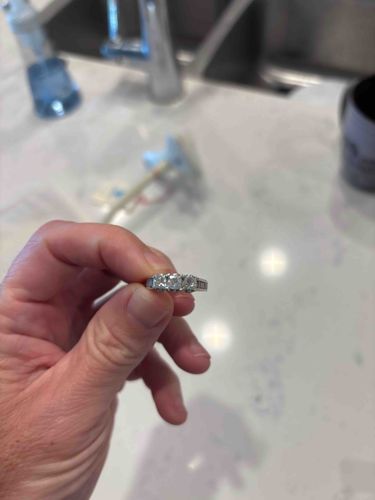
This item is a diamond ring, likely crafted from white gold or platinum, suggested by its bright, silvery luster. The ring features a prominent three-stone setting at its center, with each main stone appearing to be a round brilliant cut diamond. The size of the center stone appears slightly larger than the two flanking stones, creating a classic graduated three-stone design. The stones exhibit good fire and brilliance, indicating they are either high-quality diamonds or very convincing simulants, though visual inspection alone cannot confirm this definitively. On either side of the three main stones, the band transitions into a channel-set design, featuring smaller, possibly baguette or square-cut diamonds that extend partway down the shank. These accent stones are uniformly set, contributing to a continuous sparkling effect. The overall construction appears solid and well-made, typical of fine jewelry. No obvious damage such as bent prongs, missing stones, or significant scratches are discernible from the provided image. The metal shows a consistent finish without visible tarnish or heavy wear. The style suggests a contemporary or modern classic design, likely dating from the late 20th century to the present day. Without jeweler's loupe examination, specific clarity, color, and carat weight of the stones, nor manufacturer's marks, can be determined. However, the craftsmanship of the setting, particularly the precise channel setting, suggests a good quality piece of jewelry. The design is elegant and common for engagement rings or anniversary bands.
AI Appraisal Report
Based on my visual examination of the provided image, this Three-Stone Diamond Ring with Channel-Set Accents appears to be in excellent condition. The metal, likely white gold or platinum due to its bright luster, shows no discernible damage such as scratches, tarnish, or bent prongs. The stones, exhibiting good fire and brilliance, are well-secured within their settings. The craftsmanship, particularly the precise channel setting of the accent stones, suggests a high-quality piece. While authenticity cannot be definitively confirmed without physical inspection, the visual characteristics strongly suggest genuine diamonds.
Market conditions for classic three-stone diamond rings with channel-set accents are consistently strong. This style is perennially popular for engagement rings and anniversary bands, indicating stable demand. Comparable pieces in fine jewelry retail, depending on specific diamond characteristics and metal type, typically range from $2,000 to well over $5,000. This design is not rare, but its enduring appeal ensures consistent market liquidity.
Factors significantly impacting value include the carat weight, color, and clarity of the three main diamonds, as well as the carat weight and quality of the accent stones. The metal type is also a key differentiator; platinum would command a higher value than 14k white gold. My appraisal range reflects the assumption of genuine, good to very good quality diamonds and either 14k white gold or platinum.
It is crucial to note the limitations of this appraisal based solely on an image. Full authentication would require an in-person examination to assess the diamonds' 4 Cs (carat, cut, color, clarity) using a jeweler's loupe, a precise measurement of the stones, and verification of any manufacturer's hallmarks or metal purity stamps. Gemological testing could definitively confirm if the stones are natural diamonds or simulants, and X-ray fluorescence (XRF) testing would confirm the exact metal composition. Without physical inspection, precise carat weight and inherent quality of the diamonds remain estimates, thus influencing the breadth of the value range provided.