AI estimate as of June 29, 2025 · verify with a professional before acting
AI-Generated · Verify before acting
Everything on this page is generated by AI for informational purposes only. AI can make mistakes — the AI may misidentify items or misattribute them (artist, maker, brand, designer, origin, era). This is not an official valuation and should not be used for insurance, sale, tax, estate, legal, or lending purposes — or any decision requiring a certified appraisal. It is not an authoritative claim about any person, brand, or rights holder — do not share or rely on it as a factual statement about a third party. Always consult qualified professionals before making financial decisions.
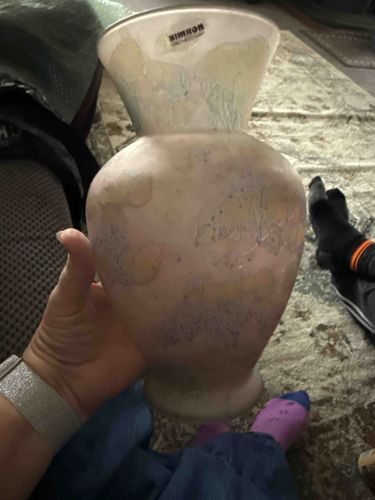
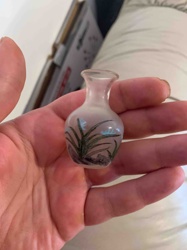
This is an art glass vase produced by Nimron, as indicated by the visible "NIMRON" label affixed off-center near the mouth of the vessel. The vase exhibits a classic-inspired silhouette, featuring a robust, bulbous body that gracefully tapers towards a proportionally narrow, round footed base, providing stability. The upper portion transitions into a pronounced flaring neck, culminating in a wide, slightly everted rim. The material is opaque or semi-opaque art glass, predominantly in an off-white or cream base color. Overlaid upon this base is a distinctive, organic, and mottled pattern featuring subtle hues of light blue, lavender, and possibly pale green or beige. These colors are diffused and distributed irregularly across the entire surface, giving the vase a unique, almost ethereal or weathered stone-like appearance. The texture, while not clearly discernible as tactile, appears to have an inherent unevenness consistent with certain art glass techniques such as spattering or internal layering. The manufacturing method is consistent with blown glass, followed by specialty decorative applications. In terms of condition, the vase appears to be in good overall state, with no immediately visible chips, cracks, or significant structural damage. Minor surface dust or minimal residue is present, particularly within the textured areas, which is standard for decorative items. The craftsmanship suggests a commercially produced art glass piece, designed primarily for aesthetic enhancement in a contemporary interior setting. Based on stylistic cues and known production periods for brands like Nimron, this piece likely dates from the late 20th or early 21st century. Its unique coloration and form make it a distinctive decorative object.
AI Appraisal Report
Upon examining the provided images of this Nimron Art Glass Vase, I assess its overall condition as good. There are no visible chips, cracks, or significant structural damage apparent from the photographs. Minor surface dust is noted, which is standard for decorative items and easily removable.
The presence of the "NIMRON" label, while off-center, indicates its manufacturer. The vase's classic-inspired silhouette, bulbous body, flaring neck, and especially its unique opaque, mottled patterning in subtle blues, lavenders, and creams are consistent with commercially produced art glass from the late 20th or early 21st century. This distinctive aesthetic gives it strong decorative appeal within contemporary settings.
The market for this type of decorative art glass is generally stable, with a consistent demand from interior decorators and collectors seeking aesthetically pleasing pieces. While the unique coloration enhances its attractiveness, Nimron is not recognized as a preeminent studio glass artist/company commanding high prices, positioning it within a broader commercial art glass market. Comparables by similar commercial producers of the period often trade in modest ranges, reflecting its decorative rather than fine art status. Its commercial origin means it is not inherently rare as a unique artistic creation.
Key factors impacting its value positively include its good condition and distinctive design. The main limiting factor is its production as a commercial item rather than a unique studio piece, preventing it from achieving higher values associated with rare, artist-signed, or antique examples.
It is crucial to note that this appraisal is based solely on visual inspection of images. Without physical examination, I cannot conclusively verify the permanence or originality of the "NIMRON" label, nor can I conduct a tactile assessment for minute surface imperfections or internal flaws. Full authentication would ideally involve in-person examination, and potentially provenance documentation, to confirm its complete history and original state.