AI estimate as of July 14, 2025 · verify with a professional before acting
AI-Generated · Verify before acting
Everything on this page is generated by AI for informational purposes only. AI can make mistakes — the AI may misidentify items or misattribute them (artist, maker, brand, designer, origin, era). This is not an official valuation and should not be used for insurance, sale, tax, estate, legal, or lending purposes — or any decision requiring a certified appraisal. It is not an authoritative claim about any person, brand, or rights holder — do not share or rely on it as a factual statement about a third party. Always consult qualified professionals before making financial decisions.
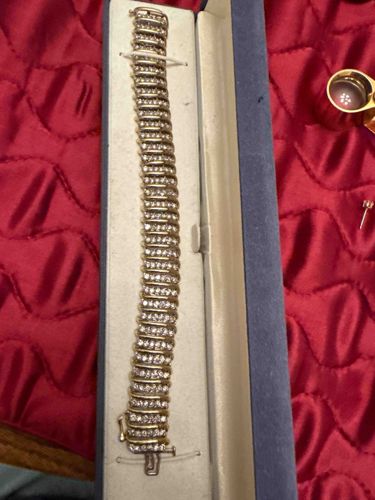
The item appears to be a vintage or antique tennis bracelet crafted from a yellow-toned metal, likely gold or gold-plated, and adorned with numerous round-cut gemstones, most likely diamonds or cubic zirconia, set in a channel or shared-prong setting. The bracelet features multiple rows of these stones, possibly two to three rows across its width, creating a substantial and elegant appearance. Each segment of the bracelet holds a row of stones, and these segments are articulated, allowing the bracelet to flex and conform to the wrist. The overall length appears suitable for a standard wrist size. The color of the metal is a warm, rich gold tone, complementing the brilliance of the clear, colorless stones. The setting style allows for maximum light exposure to the stones, enhancing their sparkle. A notable feature is the integrated clasp mechanism visible at one end, which appears to be a box clasp with a safety catch, indicative of good craftsmanship to secure such a valuable piece. In terms of condition, the stones appear to be intact with no visible chips or missing pieces, and the metal shows a consistent finish, suggesting good care, though minor surface wear consistent with age and use (e.g., light scratches, slight patina) cannot be fully ruled out from the image. The bracelet is presented in what appears to be a velvet or felt-lined blue jewelry box, suggesting it is well-preserved. There are no discernible maker's marks or signatures visible from this angle, making it difficult to ascertain specific manufacturing details or precise age, but the design suggests a classic, timeless style that has been popular for several decades.
AI Appraisal Report
I have examined the provided image of what appears to be a multi-row tennis bracelet. The design is classic, featuring multiple rows of what I visually assess as round-cut stones set in a yellow-toned metal. The articulation and visible box clasp with a safety catch indicate a well-constructed piece. The stones appear clear and intact, suggesting good preservation. Given the warm yellow tone, the metal is likely gold or gold-plated. If the stones are genuine diamonds, their brilliance is good, and the setting maximizes light exposure. If they are cubic zirconia, the visual appeal closely mimics diamonds, but the intrinsic value is significantly lower.
Market conditions for multi-row tennis bracelets, especially those with significant carat weight (if diamonds), are generally stable, with demand for classic styles remaining consistent. Rare pieces might command a premium, but this design appears to be a standard, though elegant, offering. The primary factors impacting value here are the metal purity (e.g., 14K, 18K gold vs. plated base metal) and, most critically, the identity and quality of the gemstones (natural diamonds vs. simulants). Without physical inspection, I cannot confirm if the stones are genuine diamonds or simulants like cubic zirconia, nor can I ascertain their clarity, color, or carat weight. The presence of a safety catch on the clasp is a positive sign of durability.
My valuation is heavily constrained by the inability to perform an in-person examination. To provide a definitive appraisal, I would require a gemological examination to confirm the identity, quality, and carat weight of the stones. Similarly, a metal purity test would be essential to determine if it is solid gold and its karatage. Provenance documentation, such as original purchase receipts or diamond grading reports, would also significantly aid in authentication and valuation. Without these, any valuation is speculative and subject to significant adjustment based on a physical assessment.