These notes were written by the person who submitted this item. Appraiser.AI has not verified them, and the AI's identification and estimate may rely on them.
AI Estimated Value
Not an official valuation
$75-150
AI estimate as of September 19, 2025 · verify with a professional before acting
AI-Generated · Verify before acting
Everything on this page is generated by AI for informational purposes only. AI can make mistakes — the AI may misidentify items or misattribute them (artist, maker, brand, designer, origin, era). This is not an official valuation and should not be used for insurance, sale, tax, estate, legal, or lending purposes — or any decision requiring a certified appraisal. It is not an authoritative claim about any person, brand, or rights holder — do not share or rely on it as a factual statement about a third party. Always consult qualified professionals before making financial decisions.
This analysis also relies on unverified notes provided by the user, which may be incomplete or inaccurate and could affect the result.
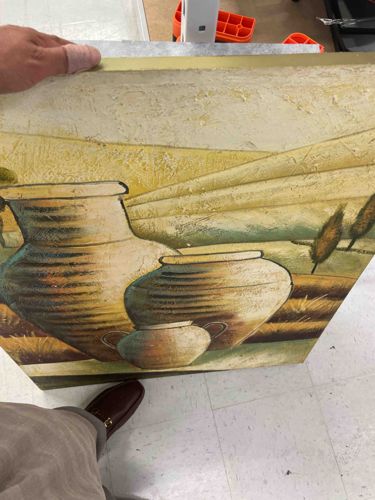
This appears to be a textured wall art piece, likely a painting or print on canvas, depicting a still life of traditional pottery vessels set against a stylized landscape. The artwork features three earthenware-style pots or jars of varying sizes in the foreground, rendered in earthy tones of beige, brown, and hints of teal. The largest pot is on the left, an intermediate one on the right, and a smaller one nestled between them. The pots exhibit horizontal striations, possibly suggesting their ceramic nature or artistic rendering to add dimension. The background portrays a minimalist landscape with rolling hills or fields in shades of light yellow, beige, and olive green. The most notable physical characteristic is the heavy texture applied to the surface, particularly visible in the sky area and the lighter parts of the landscape, creating a tactile and three-dimensional effect. This texture gives the piece a stucco-like or impasto appearance, enhancing its decorative quality. The overall color palette is warm and natural, dominated by yellows, greens, and browns. No apparent frame is visible, but the edge suggests it might be a gallery-wrapped canvas or mounted on a board with painted sides. Visible condition issues are minimal from the provided image, though the heavy texture might be prone to chipping if mishandled. There are no discernible artist signatures, maker's marks, or manufacturing details visible. The style leans towards decorative contemporary art, possibly inspired by Mediterranean or rustic motifs. Given the aesthetic and textured application, it likely dates from the late 20th century to the present day. The craftsmanship appears to be commercially produced or mass-market decorative art, designed to add warmth and a touch of traditional, rustic charm to an interior space.
AI Appraisal Report
Upon examining the images of this textured wall art, my assessment is that it is a piece of contemporary decorative art, likely mass-produced for the interior design market. The artwork depicts a rustic still life of pottery against a stylized landscape, executed in a warm, earthy color palette. The most prominent feature is the heavy, impasto-like texture across the surface, which gives it a tactile quality. The style is common and designed to complement a wide range of home decors, suggesting it is not a work by a listed artist.
The condition appears good from the visual evidence, with no obvious signs of significant damage, though the heavy texture could be susceptible to chipping. The value is primarily determined by its decorative appeal rather than any artistic merit or rarity. The market for unsigned, mass-market decorative art is driven by home furnishing trends. Comparable pieces, often sold through home goods retailers or online marketplaces, typically fall within the $75 to $150 range. The lack of an artist signature, unique provenance, or distinguished craftsmanship are significant factors limiting its value beyond a decorative object.
It is crucial to note the limitations of an appraisal based solely on images. Without a physical examination, I cannot definitively determine the medium—whether it is an original painting or a textured giclee print—nor can I assess the true condition of the substrate and texture. Full authentication would require in-person inspection to look for any hidden signatures or manufacturer's marks and to analyze the materials firsthand. However, based on all visible characteristics, its value lies firmly in the realm of decorative home decor.