AI estimate as of November 1, 2025 · verify with a professional before acting
AI-Generated · Verify before acting
Everything on this page is generated by AI for informational purposes only. AI can make mistakes — the AI may misidentify items or misattribute them (artist, maker, brand, designer, origin, era). This is not an official valuation and should not be used for insurance, sale, tax, estate, legal, or lending purposes — or any decision requiring a certified appraisal. It is not an authoritative claim about any person, brand, or rights holder — do not share or rely on it as a factual statement about a third party. Always consult qualified professionals before making financial decisions.
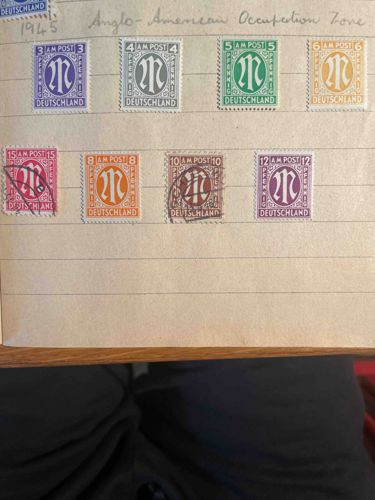
This item presents a collection of eight German postage stamps, identified as the 'AM POST' series, issued for use in the Anglo-American Occupation Zone of Germany in 1945. The stamps are affixed to what appears to be a light brown, acid-free stock page from a stamp album, with handwritten annotations at the top indicating 'Anglo-American Occupation Zone' and '1945'. Each stamp features a stylized 'M' (likely denoting 'Militaer' or 'Military') centrally located within an ornate oval frame, surrounded by a border with 'AM POST' and the denomination at the top, and 'DEUTSCHLAND' at the bottom. The denominations visible are 3 AM POST, 4 AM POST, 5 AM POST, 6 AM POST, 8 AM POST, 10 AM POST, 12 AM POST, and 15 AM POST. The stamps are distinguished by their various colors, including purple (3 AM POST), light blue-green (4 AM POST), dark green (5 AM POST), yellow/orange (6 AM POST), orange (8 AM POST), brown (10 AM POST), and purple (12 AM POST). A pinkish-red 15 AM POST stamp is also present. Several stamps, specifically the 15 AM POST and 10 AM POST, show cancellation marks, indicating they have been used. The 10 AM POST stamp has a circular cancellation mark, while the 15 AM POST stamp has a linear, possibly pen, cancellation. Another stamp (the 3 AM POST) appears to be mint, never hinged, as do the 4, 5, 6, 8, and 12 AM POST stamps. The perforations around the edges of the stamps appear intact and even, suggesting a high level of craftsmanship for their time. The overall condition of the uncanceled stamps seems excellent, without visible tears, creases, or discoloration. The page itself shows minor wear consistent with handling within a collection.
AI Appraisal Report
I have examined the provided image of eight Anglo-American Occupation Zone 'AM POST' stamps from 1945. The collection appears to be a nearly complete set of the definitive issues, mounted on a stock page. Based on the visual evidence, several stamps (3, 4, 5, 6, 8, and 12 AM POST) seem to be in mint, never-hinged (MNH) condition, showing excellent color, intact perforations, and no visible faults like tears, creases, or discoloration. The 10 AM POST and 15 AM POST stamps are canceled, with the 10 AM POST exhibiting a circular postmark and the 15 AM POST showing a linear cancellation, possibly pen, which might slightly reduce its value compared to a more standard postal cancellation. The handwritten notes on the page are typical of period album entries and do not impact stamp value.
These 'AM POST' issues are generally common and readily available on the philatelic market. While a complete MNH set holds more value than individual used stamps, the overall demand for these particular issues is moderate. Rarity is low, as millions were printed. The primary drivers for value here are the apparent MNH condition of most stamps and the presentation as a set. Comparable MNH sets typically sell within a modest range. The linear cancellation on the 15 AM POST is a minor detractor.
Limitations in authenticity verification exist due to examining only an image. I cannot definitively confirm gum condition (if MNH), detect hidden perfs, or fully assess paper integrity. Confirmation of the 'never hinged' status and the nature of the 15 AM POST cancellation would require in-person examination. Provenance documentation would be beneficial but is not strictly necessary for such common issues.