These notes were written by the person who submitted this item. Appraiser.AI has not verified them, and the AI's identification and estimate may rely on them.
AI Estimated Value
Not an official valuation
$75 - $125
AI estimate as of October 11, 2025 · verify with a professional before acting
AI-Generated · Verify before acting
Everything on this page is generated by AI for informational purposes only. AI can make mistakes — the AI may misidentify items or misattribute them (artist, maker, brand, designer, origin, era). This is not an official valuation and should not be used for insurance, sale, tax, estate, legal, or lending purposes — or any decision requiring a certified appraisal. It is not an authoritative claim about any person, brand, or rights holder — do not share or rely on it as a factual statement about a third party. Always consult qualified professionals before making financial decisions.
This analysis also relies on unverified notes provided by the user, which may be incomplete or inaccurate and could affect the result.
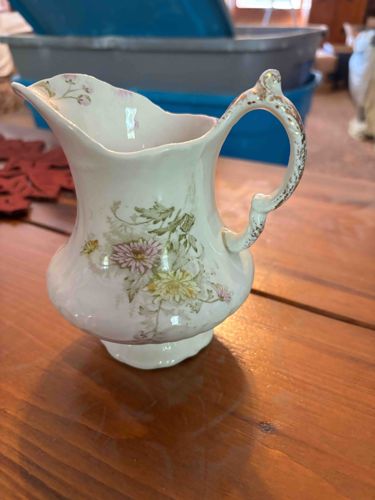
This item is a decorative porcelain creamer or small pitcher, exhibiting characteristics typical of late 19th or early 20th-century ceramic ware, likely Victorian or Edwardian in style. The body of the pitcher is primarily white or off-white with a glossy glaze. It features a bulbous lower section transitioning to a narrower, slightly flaring neck with a scalloped or undulating rim. The base appears to be a small, circular foot. The most prominent decorative elements are the hand-painted or transfer-printed floral motifs in muted tones of pink, yellow, and green, depicting chrysanthemums or similar aster-family flowers with accompanying foliage. The handle is an elegant, open-loop design, adorned with what appears to be gilded accents, which show some wear and possibly minor tarnishing, indicating its age and use. The overall condition is described as 'Excellent', suggesting minimal chips, cracks, or significant damage, though some light wear consistent with age and handling, such as minor crazing or slight loss to the gilding, might be present upon closer inspection. The mention of 'Ursula' on the bottom, if it is indeed a maker's mark or signature, would be a crucial detail for identification and provenance. Without clearer images of the base, precise manufacturing details or a definitive age can only be broadly estimated. The craftsmanship appears to be of good quality, evident in the delicate floral application and the sculpted form. This piece likely served a functional purpose but also possessed significant decorative appeal.
AI Appraisal Report
Based on my visual examination of the provided image and the owner's description, this Victorian porcelain creamer/small pitcher with floral decor appears to be in excellent condition, consistent with its stated grade. The glossy white glaze, bulbous form, scalloped rim, and elegant open-loop handle are all characteristic of late 19th or early 20th-century ceramic production. The hand-painted or possibly transfer-printed floral motifs, featuring chrysanthemums in muted tones, are well-executed. I note the gilded accents on the handle, with some wear, which is expected for an item of this age and adds to its authenticity as an antique.
The market for decorative Victorian porcelain like this piece is generally stable but not exceptionally strong for unmarked or generically marked items. While attractive, pieces of this type, unless associated with a highly sought-after maker or significant provenance, typically fall into the collectible rather than investment category. The 'Excellent' condition is a significant factor in maintaining its value, as chips, cracks, or extensive gilding loss would greatly diminish it. Demand for such items is moderate, driven by collectors of antique porcelain, Victorian decorative arts, and those seeking accent pieces for period decor. Rarity is not a major factor here, as similar pitchers were produced in considerable quantities during the era.
The mention of 'Ursula' on the bottom is crucial. If this is a recognized maker's mark or artist's signature, it could significantly impact the value, potentially increasing it. However, without a clear image of the mark, I cannot verify its authenticity or significance. Limitations in authenticity verification from images alone include the inability to inspect for restoration, true crazing versus surface scratches, or the exact method of decoration (hand-painted vs. transfer print with hand-finishing). A physical inspection would allow for detailed examination of the base mark, assessment of texture, weight, and a professional tap test for structural integrity. Provenance documentation, if available, would further enhance its historical and market value.